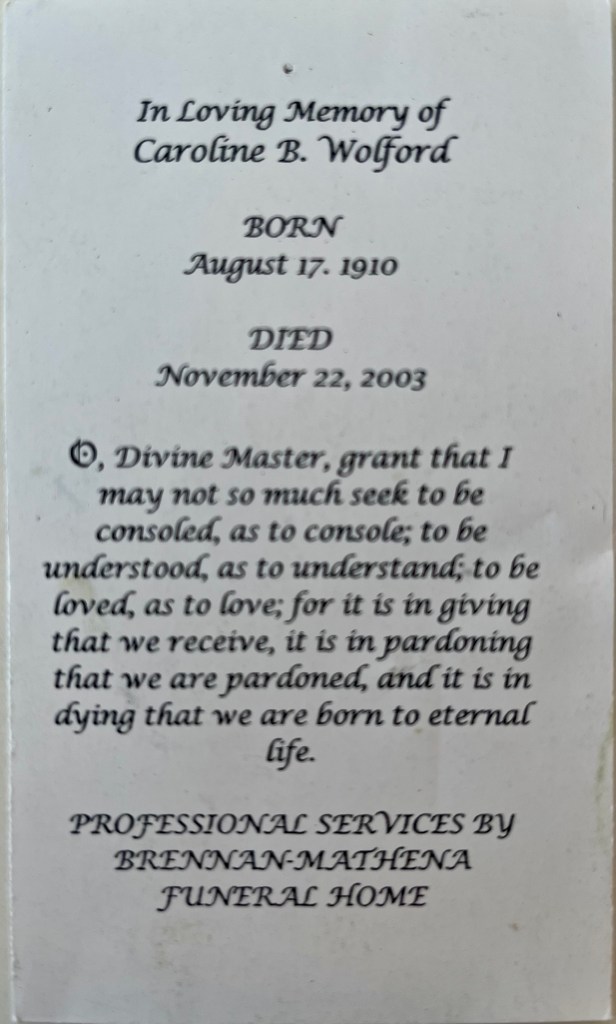
The Wolfords in February 1957

I’ve recently been given a large collection of Witt family photos to scan, and among them is this gem. This photo shows four generations of Wolfords, Witts, and Thomas’s. The back of the photo reads:

Taken Feb 1957
Family group of children, grandchildren, and great-grandchildren of
Mr. and Mrs. Carl Porubsky
1015 N. Madison St
Topeka, Kans.

Front Row: Danny Thomas, Carl Porubsky, Elizabeth Schulmeister Porubsky, Caroline Porubsky Wolford, David Witt (in Caroline’s lap), Raymond Wolford, Diane Thomas

Back Row: Walt Thomas, Betty Wolford Thomas, Barbara Wolford Witt (holding Rebecca Witt), and Howard Witt (holding Julie Witt)

Source:
Family photo of Carl and Elizabeth Porubsky, Raymond and Caroline Wolford and their children and grandchildren, photograph, taken at 1015 N. Madison St., Topeka, Kansas, in February 1957; digital image, photocopy of original, scanned in 2026 by Joseph Lowry; privately held by Rebecca Lowry [address for private use], Poland, Ohio; Family group sitting on a couch or standing behind it in a living room setting; Provenance is Barbara Witt to Rebecca Lowry.

The Porubskys from Russia to Topeka

The text below was provided by my grandmother, Barbara Witt Viti, as a photocopy of a document titled “The Origin of the German Russian People.” This three-page document summarizes the Porubsky genealogy and was likely typed in the mid to late 1980s. Based on the memories shared, the narrative style, and the focus on Carl Porubsky, I believe this was written by my great-grandmother, Caroline Porubsky Wolford. I have copied the text here exactly as it appears with no edits. It’s a fascinating read into the life of the Volga Germans living in the “Little Russia” neighborhood of Topeka, Kansas.

Page 1:

THE ORIGIN OF THE GERMAN RUSSIAN PEOPLE

About 250 years ago, Catherine of Russia, who was of German birth, wanted to bring better farming to Russia, and made a deal with a group of German farmers who were dissatisfied with the military. She promised if they would move to Russia they would be given free land and freedom from taxes and military service. They settled along the Volga taking with them seed for the wheat they grew so successfully through good farming, their thirst, their lose of peace. It was probably one of the most unusual interludes ever known in human living. Freedom from war, debt and taxes. The Germans did not intermingle with the Russians nor learn the language. They kept their own customs and brought their children up in the ways and speech of their own country. There were a little Germany inside the Russian borders. After Catherine’s era, conditions changed for the little colony. They were being taken for the military, the same as they had been in Germany. After long deliberation and mixed emotions, Mathius Porubsky, his wife Christina and 5 children decided to come to America. There was much sadness in leaving their parents and remaining sisters, brothers and relatives they possibly never see again and most families did not. The families described the feelings as a living death.

The year 1900, the Porubsky’s boarded ship and sailed rough ocean waters for 21 days. Most people became sea sick. The weather was cold, and the water of the 21 days on ship were very bad. They landed in Baltimore, Maryland and needles to say their happiness was great to be able to set foot on American soil. Most of the people kneeled down and gave thanks with eyes and clasped hands raised to heaven.

Addundum: They left Bramin [Bremen] Germany, and boarded the S.S. Roland Ship. The Porubsky family came directly to Topeka. A family of distant relatives had come to Topeka, established their home and sent them money for passage. The cost of the passage for the family was $253.00. The Porubsky family lived in the home of these people until they could establish a home of their own. Carl was 15 years old and the oldest of the children, Matthew was a small baby. The father of the family felt a heavy responsibility on his shoulders. New country, no home, no work and a debt to repay. He soon found farm work. Carl worked along his father to help provide for the family. The younger children were sent to school. Carl received little schooling but became educated in his own right and trades he learned later in life. Father and son walked 6 miles each way to the farm work. Their wages was 50 cents a day. The father soon went to work for the Santa Fe Railroad which paid a little more money. Carl continued his farm work, bought a bicycle to ride to and from his work. It was a custom of the german people all children were subject to their parents until they were 21 years old, and each child turned his weekly earnings into the house for spending money.

A small 2 room house was built by the family near the river banks of north Topeka. Everything was going well. In 1903 another son was born to the family. The same year, Topeka was flooded and the family lost most of their possessions. They rebuilt their home and replaced their possessions. In 1908 another flood came and they went with the same procedure as the 1903 flood. After the 1908 flood a large home was built for the family about 2 blocks from their first home site. The father continued to work for the railroad until he was old enough to retire. Mother Christina wife of Mathius died at an early age of 54. Death due to cancer. She died March 22, 1916. Four years later Mathius remarried a widow named Barbara Schwert with whom he lived 10 years until his death. He was 73 and died March 23, 1929. Barbara lived to be in her 80’s. She walked to church every morning for years to and from from about 1 1/2 miles. Her death occurred suddenly when a car reered out of control striking her on her own porch steps. Mathius’s 2 wives are buried in the same plot in Mt Calvary cemetery. Most all of the relatives are buried at Mt Calvary cemetery.

Page 2:

Some families formed their own settlement and was called by american people as “Little Russia.” The neighborhood still carries the name. Their houses were well kept. Everyone had a picket fence. Well painted rows of houses, mostly alike. They had what they called “summer kitchens” that was behind the main home about 25 feet from the back door. The purpose of these was to do the dirty work. The laundry, also cooking in the summer time to keep from heating up the house. The men used to for a washroom when they came from work. The young folks used it for dancing. There was always some one in a group that could play some type of musical instrument. Most all could play a harmonica. The men folks used the kitchen which sometimes consisted of 2 rooms for playing cards, chewing their tobacco and filling their pipes. The women frowned on their husbands dirtying their kitchen in the main house. They took turns at each others homes. The people prowdly kept their german language. Some of the older people learned to speak a little english and understand the language and others did not but they were happy in their state of life. As their children learned the english language and customs the parents also liked the new ways. These people were all of the catholic faith, all would have to gather at night usually kneel on a bare printed floor and say the rosary. For anyone that has not done this, this was a real penance. The elderly did not fidget as much as the young and by the time the last decade of the rosary was reached it was hard to concentrate on god. These people were very strict with their children and expected obedience from them. Many of the men found work farming[,] others carpenter work, many worked for the railroad from the time they came to america until they died. Others worked for a meat packing plant. They often thought of the remaining relatives in Russia. Many letters were written and money sent to them but few ever heard that their mail was received. The women often times took their babies with them to do a washing by hand for the wealthier people to help the husbands to pay the debt of money for their passage to this country.

Christmas was never a big day in gift giving but regarded as the day Christ was born and celebrated as such. The immediate family received small gifts- candy & fruit aplenty for the children. The children never heard of Santa Claus with the white whiskers and red suit but all knew of St. Nickless. He some times came to the house dressed in white, nearest resemblance to a spook with heavy chain around the waist. Some children eager to meet him and others feeling they hadn’t been very good throughout the year crawled under the beds. New years day was a big day for celebrating. The families went to all of their relatives and visited & did what we called “winching”. In reality it was a happy new year wish that in german translated in english is: I wish you a happy new year, long life, good health, freedom and peace in your life, after your death life everlasting. May the love of the christ child remain in your heart forever, these are my wishes for you. Children learned to say this young in age. Food was prepared in advance that was of german dishes, such as cabbage strudles made by browning meat, adding cabbage, onions & seasoning, wrapping in bread dough, dropped in deep fat or baked. Home made pickles, whole pickled watermelons. The basement had potatoes, apples, cheese. Everyone had a cow. Lunch meats, ham, pretzels, beer, liquor served to adults. The children received candy, oranges, and money. Many times there would be 100 people at our home on that day. Many people started the new year celebration the minute the clock struck 12:00 and lasted all night and day. January 2nd there would were many that could vaguly remember where they had been or what they had eaten.

Weddings called for a 3 day celebration if the parents could afford it. The 2nd or 3rd day was a close family celebration to eat the remaining food and drink beer. This was a mock wedding. The man usually portrayed the bride with lace curtains as a veil, flowers from spirea bushes as bridal wreath, bunch of onions as bouquet. The groom was a woman dressed in mans clothing usually dressed in overalls resembling a hillbillie and small in size and stood on a box next to his bride. This was a great fun day. Some weddings today still do this.

Page 3:

One good old custom stays- that of pinning money to the dress of the bride. by the men who dance with her on her wedding day. The dance was called “Russian Stomp” and began after the nuptial mass and wedding breakfast ending at 12:00 midnight. It is customary for brothers and sisters husbands to pin at least a $20.00 bill which considering the larger families is a large sum. It has been known for the father of the bride to pin $500.00 to his daughter’s dress and the grooms father a check for equal amount. Formerly the groom’s parents furnished the dinner for all of the relatives and friends at noon following the wedding but now American custom is followed and the bride’s parents supply the food. The present custom is for the bride and groom to furnish the refreshments and drinks for the evening of the wedding day. The kitty for the musicians is a dulcimar into which the dancers drop coins or bills. There is a guarantee in case the kitty is not fat enough. The couples take in about 3 times what they spend. Many couples have netted as much as $2700.00 to start a life of their own.

The people in this little section of town are industrious, proud of their heritage and still peace loving. Their thrift and skill both on the farm and in other occupations and the determination to follow an idea that brought them first to Russia and then to america makes them valuable citizens. They studied and became american citizens and to be able to vote was a great privilege.

The Porubsky children according to age were: Carl, John, Anna, Joseph, Elizabeth, Matthew and George.

Carl Porubsky, born Feb 26, 1865, died Feb 14, 1962 age 77, member of St. Joseph’s church, buried Mt. Calvary cemetery, he was born in Kemanka Russia

John Porubsky, born April 5, 1887 in Kamenka Russia, died August 23 1956, member of Sacred Heart Catholic Church, Topeka, buried Mt. Calvary

Anna Porubsky Wasinger, lived in Chicago, Ill, died in mid 40’s

Joseph Porubsky, born December 7, 1892, died November 6, 1940, member St Josephs catholic church, buried Mt Calvery cemetery

Elizabeth Porubsky Devlin, born Jan 31, 1894 in Kamenka, Russia, died Jan 9, 1964, member of St Joseph catholic Church, buried Mt Calvary cemetery

Matthew Porubsky, born March 16, 1900, died August 17, 1948, member St Josephs catholic Church, buried Mt Calvary cemetery

George Porubsky, born March 2, 1903, died August 16, 1962 member St Joseph’s Catholic Church, buried Mt Calvary cemetery
Census Sunday – The Rabe Family in 1910

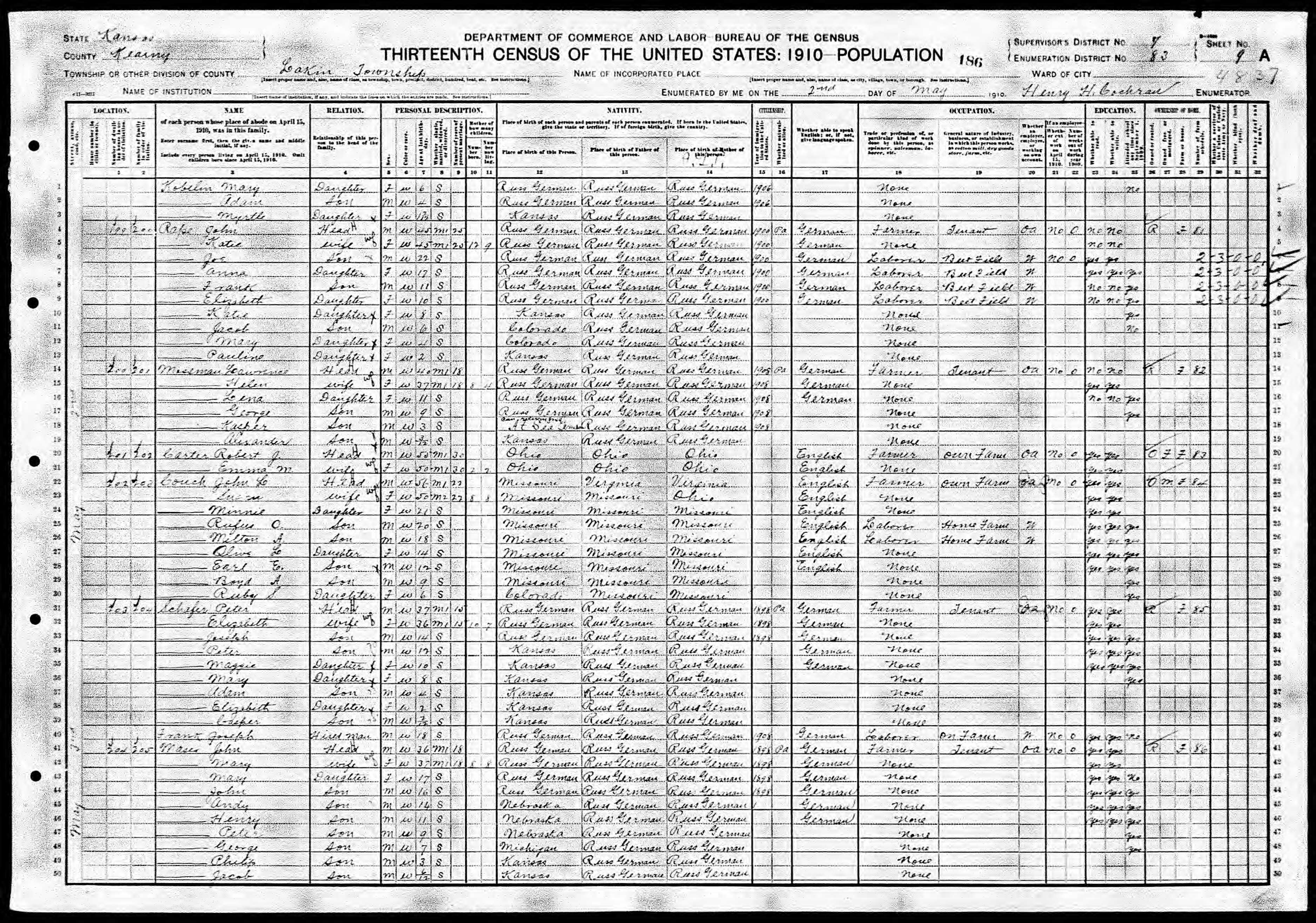
The amazing thing about genealogy is that sometimes a record that seems so minor to your larger family history can lead to connections across multiple families and fill so many blanks. Such is the case of the Rabe family of Topeka, Kansas.

Late in the night, when I tend to lose focus on my research, I bounce from ancestor to ancestor, adding records to my family tree as I stumble upon them. One record collection I was aware of but hadn’t searched in sometime was the “United States, Obituaries, American Historical Society of Germans from Russia, 1899-2012″ collection on Familysearch.org. As my Porubsky and Schulmeister ancestors are Volga Germans, I did a simple surname search for Porubsky. In the process, I located the obituary of Catherine Porubsky (Reeb).

2016-08-15_1507.png

In reading the names in this record, I instantly recognized Porubsky and Schwerdt. Reeb sounded familar, but my Topeka relatives were Rabes, not Reebs. Catherine Rabe was in my family tree, married to Matthew Porubsky, but she lacked parents in my database. In fact, I had three Rabes in my tree and they all lacked parents.

  • Catherine E. Rabe was married to Matthew G. Porubsky
  • Elizabeth B. Rabe was married to Joseph A. Schulmeister
  • Joseph Rabe was married to Caroline Schulmeister

The three Rabes lived in Topeka and were born within 15 years of each other. The original obituary named a sister Pauline, but no other siblings. Could they be related? I set to find out! I knew she was born in 1901 to John and Catherine, who were born in Russia. From other record sources, I also knew that Elizabeth was born in 1889 and Joseph in 1887. I located a Rabe family in the 1910 United States Census. The details I previously had confirmed from later census and marriage records fit well with this 1910 record.

The three Rabes in my family tree were siblings, and each had married into the family of my ancestors, making them my 3rd great aunts and uncles.

John_Rabe_1910_USCensus_Ancestry

State: Kansas
County: Kearny
Township: Lakin
Name of Incorporated Place:
Ward of the City:
Enumerated by me on the 2nd of May
Henry H. Cochran, Enumerator

Supervisor’s District: 7
Enumeration District: 83
Sheet No. 9A

Dwelling No. 199
Family No. 200

Address: Unknown (not listed)

Rabe, John, head, male, white, 45 years old, 1st marriage, married 25 years. Born in Russ German. Father born in Russ German. Mother born in Russ German. Immigrated in 1900. Has applied for citizenship and has his first papers (Pa.). Speaks German. Works as a tenant farmer working on his own account (meaning, not an employee or employer). Is not out of work; out of work 0 weeks in prior year. Can read: No. Can write: No. Rents the farm, which is found on Agriculture Schedule 81.1

” Katie, wife, female, white, 45 years old, 1st marriage, married 25 years. 12 children born, 9 still living. Born in Russ German. Father born in Russ German. Mother born in Russ German. Immigrated in 1900. Speaks German. Not employed. Can read: No. Can write: No.

” Joe, son, male, white, 22 years old, single. Born in Russ German. Father born in Russ German. Mother born in Russ German. Immigrated in 1900. Speaks German. Employed as a laborer in the beet fields. Can read: Yes. Can write: Yes.

” Anna, daughter, female, white, 17 years old, single. Born in Russ German. Father born in Russ German. Mother born in Russ German. Immigrated in 1900. Speaks German. Employed as a laborer in the beet fields. Can read: Yes. Can write: Yes. Attended school anytime since September 1, 1909: Yes.

” Frank, son, male, white, 11 years old, single. Born in Russ German. Father born in Russ German. Mother born in Russ German. Immigrated in 1900. Speaks German. Employed as a laborer in the beet fields. Can read: No. Can write: No. Attended school anytime since September 1, 1909: Yes.

” Elizabeth, daughter, female, white, 10 years old, single. Born in Russ German. Father born in Russ German. Mother born in Russ German. Immigrated in 1900. Speaks German. Employed as a laborer in the beet fields. Can read: No. Can write: No. Attended school anytime since September 1, 1909: Yes.

” Katie, daughter, female, white, 8 years old, single. Born in Kansas. Father born in Russ German. Mother born in Russ German. Not employed. Attended school anytime since September 1, 1909: Yes.

” Jacob, son, male, white, 6 years old, single. Born in Colorado. Father born in Russ German. Mother born in Russ German. Not employed. Attended school anytime since September 1, 1909: No.

” Mary, daughter, female, white, 4 years old, single. Born in Colorado. Father born in Russ German. Mother born in Russ German. Not employed.

” Pauline, daughter, female, white, 2 years old, single. Born in Kansas. Father born in Russ German. Mother born in Russ German. Not employed.

Source:
1. “Catherine Porubsky,” The Topeka Capital Journal, 22 Sep 1992, pg 3D; “United States, Obituaries, American Historical Society of Germans from Russia, 1899-2012,” database with images, FamilySearch (https://familysearch.org/pal:/MM9.3.1/TH-1971-42560-12683-35?cc=2367299 : 14 August 2015), 100415107 > image 7336 of 8998; American Historical Society of Germans from Russia, Lincoln.

2. 1910 U.S. Federal Census, Kearny County, Lakin, population schedule, enumeration district (ED) 83, sheet 9A, dwelling 199, family 200, household of John Rabe; digital image, Ancestry.com (http://www.ancestry.com : accessed 15 August 2016), FHL microfilm 1374454, citing NARA publication  T624_441.

The Porubsky-Schulmeister Nuptials

“Twenty-one year old Carl Porubsky, the son of Mathias and Christina Vogelman Porubsky was wed today to eighteen-year old Elizabeth Schulmeister in a family ceremony at Saint Joseph German Catholic Church in Topeka.”

If I was writing a wedding announcement for these two, it would probably start out with my just-the-facts manner before devolving into a mess of a discussion about roses, 3-button suits, and broaches. Alas, I am not the writer of wedding announcements. This picture was taken on Karl and Lizzie’s wedding day, Sunday, 26 August 1906.¹

I don’t know the time of the service, and unlike other Christian denominations, Mass times for the Catholic churches don’t appear in The Topeka Daily Capital. The weather this Sunday was described as fair, with temperatures in the upper 70’s to lower 80’s.² Surely, for August in Topeka, it was a lovely day to get married.

Carl and Elizabeth would see this marriage last fifty-five years, until Carl’s death in 1962. Elizabeth died in 1972.

IMG_5793_Fotor copy


Sources and Notes:

  1. Names appear in the marriage license announcement as Karl Bornesky and Lizzie Schulmeister. “Marriage Licenses,” The Topeka [KS] Daily Capital, 26 Aug 1906, page 11, col 4; digital image, (http://www.newspapers.com : accessed 7 Aug 2016), Newspapers.com.
  2. “Weather Conditions,” The Topeka [KS] Daily Capital, 26 Aug 1906, page 1, col 5; digital image, (http://www.newspapers.com : accessed 7 Aug 2016), Newspapers.com.
  3. Carl Porubsky and Elizabeth Schulmeister Porubsky, photograph, taken in Topeka, Kansas, on 26 August 1906; digital image, photograph of original, taken 2016 by Joseph Lowry; privately held by Barbara Viti, [address for private use], Tallmadge, Ohio; Two young adults in marriage outfits, one a dark 3-button suit and the other a white gown with flowers; Provenance is Carl and Elizabeth Porubsky to Caroline Porubsky Wolford to Barbara Wolford Viti.

Photo of the Day – January 6, 2015

My great grandmother Caroline Porubsky Wolford had the gift of the gab, a traditionally Irish phrase, but one that applies nonetheless to this Volga German lady. From her home in Topeka, she made regular phone calls back east to her daughter Barb and granddaughters Julie, Marie and Becky in Youngstown. I’m guessing this snapshot was taken sometime in the 1980’s while great grandma made one of those calls.

Census Sunday – 1910 U.S. Census for Mathias Porubsky and Family

Click to enlarge
The 1910 Federal Census was the first for Mathias Porubsky and his family. Though they had been in the United States for 10 years, they missed the 1900 Census by just a few months, having arrived in Baltimore in June. Census enumerations are typically conducted in April. Reading the information below, there is so much interesting information to be gleaned. First of all, after just 9 years in the United States, the family owned a home free of a mortgage. Of course, many people in the household were working to support the family and probably help pay for that house. Mathias and sons Johannes and Joseph worked in the railroad shops, most likely for the Atchison, Topeka and Santa Fe Railroad. Even daughter Elizabeth, age 16, works as a laborer in a box factory. 
The Porubsky household was home to three generations. Their daughter Ann lived in the home with her husband Andrew Wasinger and their son Karl. Two boarders also lived there, who no doubt served as a source of additional income to the family. Interestingly, members of the Kaberline family lived on either side of the Porubsky’s. Mathias grandson Charles (late the owner of Porubsky’s Deli) would marry Lydia Kaberline in the 1940s. 

State: Kansas
County: Shawnee
Name of Incorporated Place: Topeka City
Ward of the City: 1
Enumerated by me on the 21th day of April
*blank*, Enumerator

Supervisor’s District: 7
Enumeration District: 142
Sheet No. 3B

Dwelling No. 64
Family No. 68
Address: 600 N Quincy Street

Porubsky, Mathias, head, male, white, 53 years old, married 27 years. Born in Austria-Hungry/Slov***. Father born in Austria-Hungry/Slov***. Mother born in Austria-Hungry/Slov***. Immigrated in 1901. *unsure if he’s listed as naturalized or alien – illegible*. Speaks German. Employed as a machinist in the R.R. shops. Is not out of work. Can read: Yes. Can write: Yes. Attended school in the last year: no. Owned a house free of a mortgage.

” Christina, wife, female, white, 47 years old, married 27 years. Number of children born: 9. Number of children living: 7. Born in Russia Ger. Father born in Russia German. Mother born in Russia (Ger). Immigrated in 1901. Speaks German. Not employed. Can read: No. Can write: No. Attended school in the last year: no.

” Johannes, son, male, white, 23 years old, single. Born in Russia German. Father born in Austria-Hungry/Slov***. Mother born in Russia (Ger). Immigrated in 1901. Speaks Ger. English. Employed as a laborer in the R.R. shops. Can read: Yes. Can write: Yes. Attended school in the last year: no.
” Joseph, son, male, white, 18 years old, 2nd marriage, single. Born in Russia German. Father born in Austria-Hungry/Slov***. Mother born in Russia (Ger). Immigrated in 1901. Speaks Ger. English. Employed as a machinist in the R.R. shops. Can read: Yes. Can write: Yes. Attended school in the last year: no.
” Elizabeth, daughter, female, white, 16 years old, single. Born in Russia German. Father born in Austria-Hungry/Slov***. Mother born in Russia (Ger). Immigrated in 1901. Speaks Ger. English. Employed as a laborer in a box factory. Can read: Yes. Can write: Yes. Attended school in the last year: no.
” Mathias, son, male, white, 10 years old, single. Born in Russia German. Father born in Austria-Hungry/Slov***. Mother born in Russia (Ger). Immigrated in 1901. Speaks Ger. English. Not employed. Can read: Yes. Can write: Yes. Attended school in the last year: yes.
” George, son, male, white, 7 years old, single. Born in Kansas. Father born in Austria-Hungry/Slov***. Mother born in Russia (Ger). Speaks Ger. English. Not employed. Can read: Yes. Can write: Yes. Attended school in the last year: no.
Kaberline, Andrew, son-in-law, male, white, 24 years old, married. Born in Kansas. Father born in Russia (Ger). Mother born in Russia (Ger). Speaks German. Employed as a machinist in the R.R. shops. Is not out of work. Can read: Yes. Can write: Yes. Attended school in the last year: no.

” Anna, daughter, female, white, 20 years old, married 1 year. Number of children born: 1. Number of children living: 1. Born in Russia Ger. Father born in Russia German. Mother born in Russia (Ger). Immigrated in 1901. Speaks Ger English. Not employed. Can read: Yes. Can write: Yes. Attended school in the last year: no.

” Karl, son, male, white, 3/12 years old (3 mos), single. Born in Kansas. Father born in Kansas. Mother born in Russia (Ger). Doesn’t speak. Not employed. Can read: No. Can write: No. Attended school in the last year: no.
Beyer, George, boarder, male, white, 24 years old, single. Born in Russia (Ger). Father born in Russia Ger. Mother born in Russia Ger. Immigrated in 1907. Alien. Speaks Ger English. Laborer in a flour mill. Is not out of work. Can read: Yes. Can write: Yes. Attended school in the last year: No.
Balosky, Joseph, boarder, male, white, 33 years old, single. Born in Austria-Hungary/German. Father born in Austria-Hungary/German. Mother born in Austria-Hungary (Ger). Immigrated in 1903. Alien. Speaks German English. Laborer who works odd jobs. Currently out of work. Can read: Yes. Can write: Yes. Attended school in the last year: No.

Source:
1910 U.S. Federal Census, Shawnee County, Topeka City, population schedule, Enumeration District 142, Sheet 3B, Dwelling 68. Mathias Porubsky; digital image, Ancestry.com (http://www.ancestry.com : accessed 20 August 2014): FHL microfilm: 1374470. National Archives microfilm publication Roll T624_457.

Treasure Chest Thursday – Manifest of the SS Roland

One hundred and fourteen years ago today, my 3rd great grandparents Mathias and Christina Porubsky, their son Carl and five of his siblings were on an adventure at sea. The Porubsky’s had left their Volga German community in Kamenka, Russia, perhaps to escape the Tsar and policies of assimilation and were en route to Topeka, Kansas. It was there that an enclave of Volga Germans had established themselves. They had set out aboard the SS Roland of Norddeutscher (North German) Lloyd. At 345 feet, the Roland was just a few dozen feet longer than today’s Staten Island Ferry. They sailed from Breman, Germany and were en route to Baltimore, Maryland.
The Porubsky family was among up to 800 people stuffed below deck in 3rd class. On June 22, 1900, they arrived at the passenger terminal along the Patapsco River and proceeded overland to Kansas.
This manifest marks their journey to a new life in America. At the time of his arrival, Mathias Porubsky was a 44-year old laborer; his wife Christina was 38. An uncle had paid their way, although the identity and relationship of this uncle remains unknown. They arrived with $20 in their pockets (about $550 in today’s dollars). Checkmarks indicate that all but the youngest two could read and write.
The manifest as located through FamilySearch.org
The manifest as located through Ancestry.com
Finding the above images was not without it’s small challenges. Both Ancestry.com and FamilySearch.org have the manifest in their record collections but neither is perfect. The two sites, which are the largest genealogical record holders in the world, only sporadically overlap so it’s not always the case that both sites will have the same record.
I retrieved the Ancestry.com manifest because it appeared as a ‘hint’ on Mathias Porubsky’s page. Ancestry.com hints allow users to quickly identify records that may be related to their ancestor and attach them to their family tree. Unfortunately, many people accept every single hint without closely examining the record to ensure it belongs to their ancestor. The Ancestry.com record was poorly scanned, as it is crooked and has several columns (18 and 19) chopped up. That said, the index (transcription) of the manifest was spot-on and I was to quickly find my ancestors on the page.
The FamilySearch.org document is a very clean scan, but slightly darker. Unfortunately, a very poor transcription for this document made it much harder to locate. The ship was listed as the SS Poland, instead of the SS Roland. I couldn’t even begin to tell you how the family name was listed because numerous searches failed to turn up anything. Having already located the Ancestry.com version of the manifest, I used my search skills knowledge to search for a simpler surname I knew was further down the same page. Sure enough, after I located ship mate Joseph Zadja, I scrolled up to find the Porubsky family.
Having these types of documents tells a lot about the travel conditions my ancestors endured to arrive at a new life. When paired with other documents, we can start to piece together a life story, which is the ultimate goal for any genealogist.

Sources:
“Baltimore, Passenger Lists, 1820-1948 and 1954-1957,” index and images, Ancestry.com (http://interactive.ancestry.com/8679/mdt844_19-0177/696872?backurl=&ssrc=pt_t28087067_p5130324876_kpidz0q3d5130324876z0q26pgz0q3d32768z0q26pgplz0q3dpid&backlabel=ReturnRecord : accessed 18 Jun 2014), National Archives and Records Administration (NARA); Washington, DC; Records of the US Customs Service, RG36; Series: T844; Roll: 19

“Maryland, Baltimore Passenger Lists, 1820-1948,” index and images, FamilySearch (https://familysearch.org/pal:/MM9.3.1/TH-1942-29149-8032-62?cc=2018318 : accessed 18 Jun 2014), 1891-1948 (NARA T844) > 19 – Jun 7, 1900-Feb 25, 1901 > image 180 of 876; citing NARA microfilm publications M255, M596 and T844.

Treasure Chest Thursday – Naturalization Index for Carl Porubsky

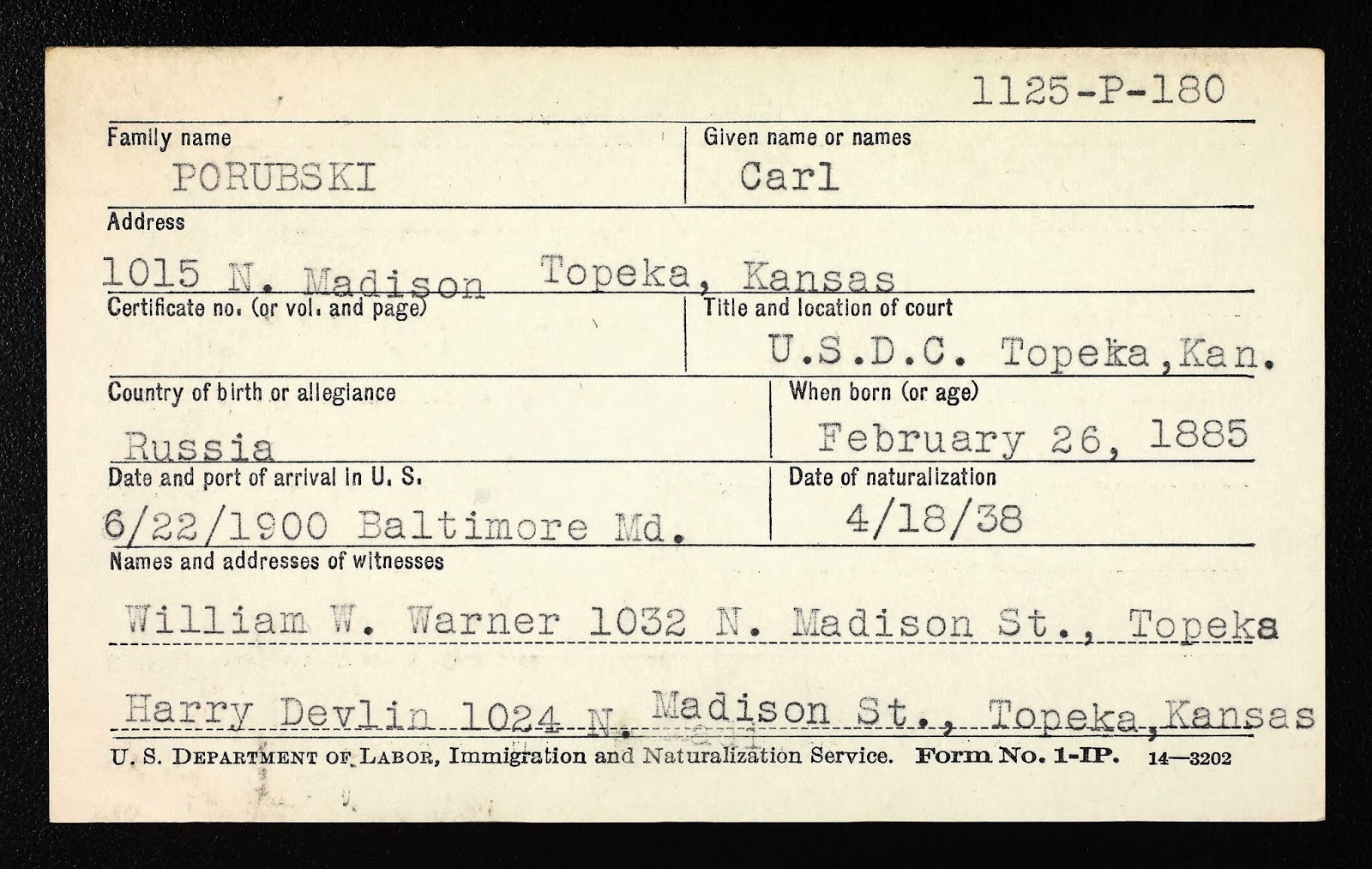
My great great grandfather Carl Porubsky arrived in the United States from Russia in 1900. He signed an intent to naturalize in 1918 but it was not until 1938 that he became an American citizen. By then, he was a 53 year old grandfather. These index cards indicate that he was naturalized in the United States District Court in Topeka, Kansas on April 18, 1938. Witnesses to the naturalization include William W. Werner, a neighbor and his brother-in-law Harry Devlin, likewise a neighbor on Madison Street. Harry was married to Carl’s sister Elizabeth.

Front. Click to enlarge.

Back. Click to enlarge.

Source:
United States. U.S. Department of Labor. Immigration and Naturalization Service. Naturalization Index for the Western District of Missouri, Compiled 1930 – 1950, Documenting the Period Ca. 1848 – Ca. 1950. N.p.: n.p., n.d. Record Group 21. Ancestry.com. Web. 21 Jan 2014. <Link>.

Matrilineal Monday – Caroline Porubsky at Age 19

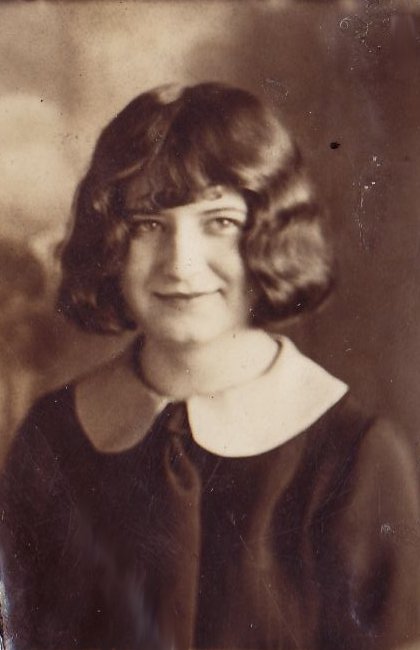
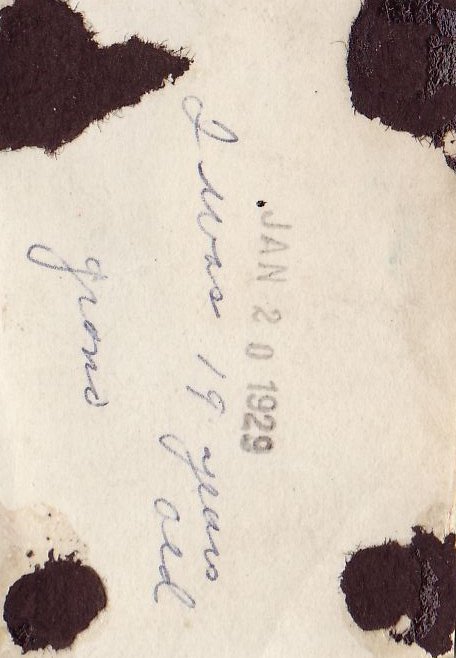
My great grandmother at age 19. This photo is stamped ‘Jan 20 1929’ while below is hand written ‘I was 19 years old’ ‘grand(sic?)’. 
I rarely scan the back of photos. Obviously, they are blank most of the time but I loved that this one included a very specific date. Imagine Caroline in her house at 1015 N Madison bundling up for the Topeka winter and heading to a photo studio. Perhaps this is a school photo? For a church directory? Maybe my grandmother has an answer…
Photo from a family collection.

Funeral Card Friday – Caroline B. Wolford

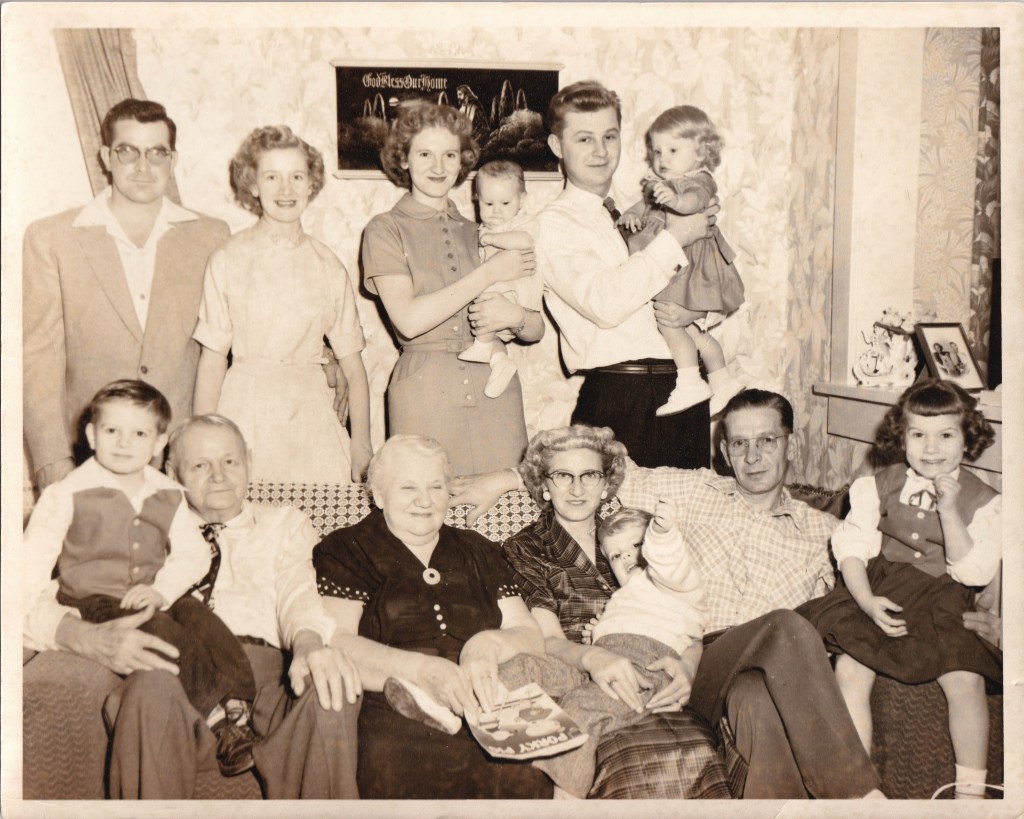
I have a small collection of funeral cards. It seems that whenever a family member dies, I don’t take one funeral card. I take seven or eight. Thus, I have a lot of funeral cards for just a few relatives. My great grandmother Caroline lived to be 93 years old. I didn’t go to her funeral as I was closing out the first semester of my senior year of college in Cleveland and the funeral was 900 miles away in Topeka. I think my mom brought this back for me. A lovely quotation from the Prayer of Saint Francis is on the card.