My great uncle William (Bill) Witt was a Catholic priest in the Diocese of Youngstown. He died on February 22, 2011, at the age of 88.
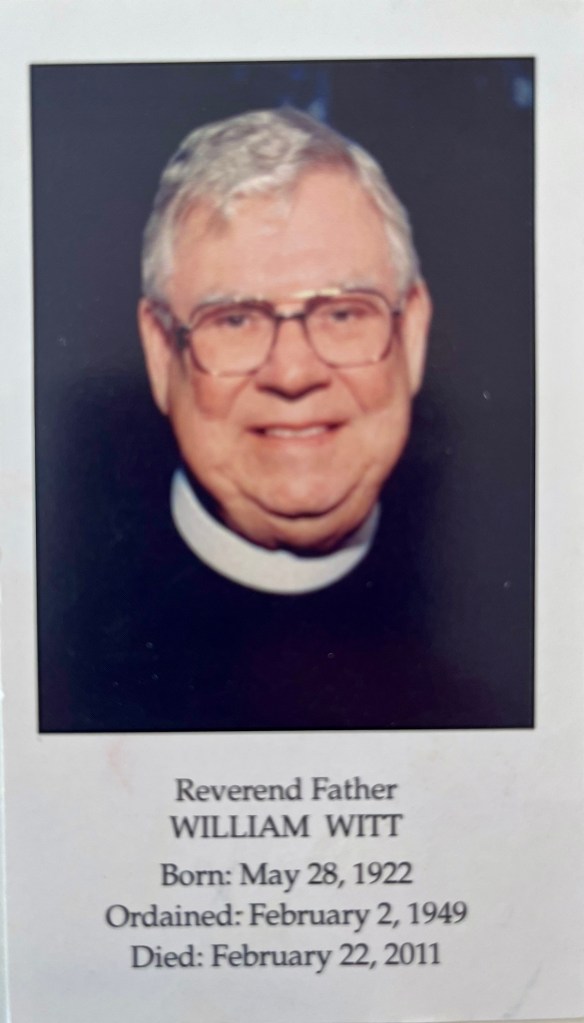
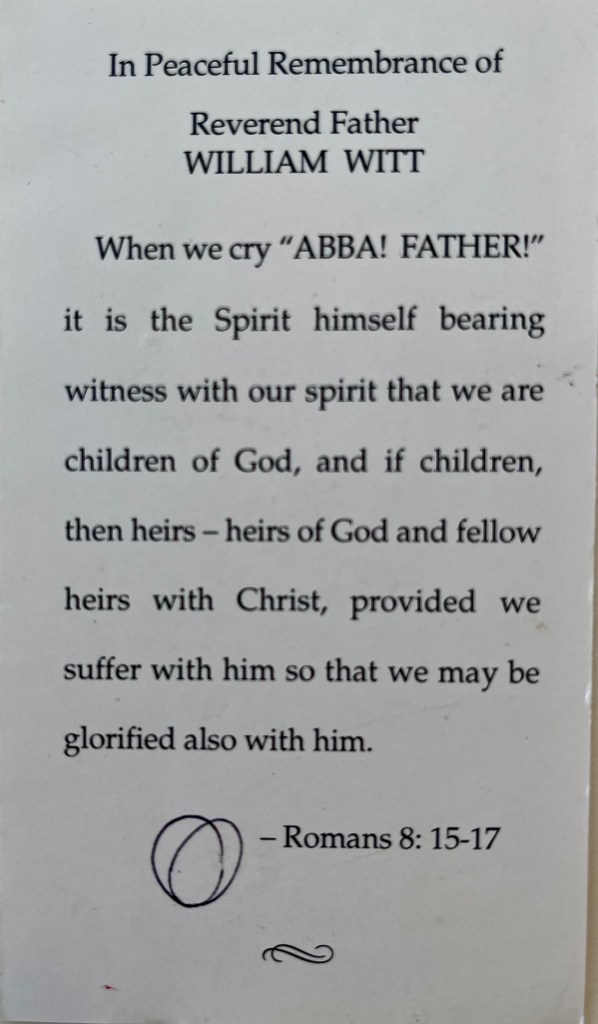
My great uncle William (Bill) Witt was a Catholic priest in the Diocese of Youngstown. He died on February 22, 2011, at the age of 88.
The text below was provided by my grandmother, Barbara Witt Viti, as a photocopy of a document titled “The Origin of the German Russian People.” This three-page document summarizes the Porubsky genealogy and was likely typed in the mid to late 1980s. Based on the memories shared, the narrative style, and the focus on Carl Porubsky, I believe this was written by my great-grandmother, Caroline Porubsky Wolford. I have copied the text here exactly as it appears with no edits. It’s a fascinating read into the life of the Volga Germans living in the “Little Russia” neighborhood of Topeka, Kansas.
Page 1:
THE ORIGIN OF THE GERMAN RUSSIAN PEOPLE
About 250 years ago, Catherine of Russia, who was of German birth, wanted to bring better farming to Russia, and made a deal with a group of German farmers who were dissatisfied with the military. She promised if they would move to Russia they would be given free land and freedom from taxes and military service. They settled along the Volga taking with them seed for the wheat they grew so successfully through good farming, their thirst, their lose of peace. It was probably one of the most unusual interludes ever known in human living. Freedom from war, debt and taxes. The Germans did not intermingle with the Russians nor learn the language. They kept their own customs and brought their children up in the ways and speech of their own country. There were a little Germany inside the Russian borders. After Catherine’s era, conditions changed for the little colony. They were being taken for the military, the same as they had been in Germany. After long deliberation and mixed emotions, Mathius Porubsky, his wife Christina and 5 children decided to come to America. There was much sadness in leaving their parents and remaining sisters, brothers and relatives they possibly never see again and most families did not. The families described the feelings as a living death.
The year 1900, the Porubsky’s boarded ship and sailed rough ocean waters for 21 days. Most people became sea sick. The weather was cold, and the water of the 21 days on ship were very bad. They landed in Baltimore, Maryland and needles to say their happiness was great to be able to set foot on American soil. Most of the people kneeled down and gave thanks with eyes and clasped hands raised to heaven.
Addundum: They left Bramin [Bremen] Germany, and boarded the S.S. Roland Ship. The Porubsky family came directly to Topeka. A family of distant relatives had come to Topeka, established their home and sent them money for passage. The cost of the passage for the family was $253.00. The Porubsky family lived in the home of these people until they could establish a home of their own. Carl was 15 years old and the oldest of the children, Matthew was a small baby. The father of the family felt a heavy responsibility on his shoulders. New country, no home, no work and a debt to repay. He soon found farm work. Carl worked along his father to help provide for the family. The younger children were sent to school. Carl received little schooling but became educated in his own right and trades he learned later in life. Father and son walked 6 miles each way to the farm work. Their wages was 50 cents a day. The father soon went to work for the Santa Fe Railroad which paid a little more money. Carl continued his farm work, bought a bicycle to ride to and from his work. It was a custom of the german people all children were subject to their parents until they were 21 years old, and each child turned his weekly earnings into the house for spending money.
A small 2 room house was built by the family near the river banks of north Topeka. Everything was going well. In 1903 another son was born to the family. The same year, Topeka was flooded and the family lost most of their possessions. They rebuilt their home and replaced their possessions. In 1908 another flood came and they went with the same procedure as the 1903 flood. After the 1908 flood a large home was built for the family about 2 blocks from their first home site. The father continued to work for the railroad until he was old enough to retire. Mother Christina wife of Mathius died at an early age of 54. Death due to cancer. She died March 22, 1916. Four years later Mathius remarried a widow named Barbara Schwert with whom he lived 10 years until his death. He was 73 and died March 23, 1929. Barbara lived to be in her 80’s. She walked to church every morning for years to and from from about 1 1/2 miles. Her death occurred suddenly when a car reered out of control striking her on her own porch steps. Mathius’s 2 wives are buried in the same plot in Mt Calvary cemetery. Most all of the relatives are buried at Mt Calvary cemetery.
Page 2:
Some families formed their own settlement and was called by american people as “Little Russia.” The neighborhood still carries the name. Their houses were well kept. Everyone had a picket fence. Well painted rows of houses, mostly alike. They had what they called “summer kitchens” that was behind the main home about 25 feet from the back door. The purpose of these was to do the dirty work. The laundry, also cooking in the summer time to keep from heating up the house. The men used to for a washroom when they came from work. The young folks used it for dancing. There was always some one in a group that could play some type of musical instrument. Most all could play a harmonica. The men folks used the kitchen which sometimes consisted of 2 rooms for playing cards, chewing their tobacco and filling their pipes. The women frowned on their husbands dirtying their kitchen in the main house. They took turns at each others homes. The people prowdly kept their german language. Some of the older people learned to speak a little english and understand the language and others did not but they were happy in their state of life. As their children learned the english language and customs the parents also liked the new ways. These people were all of the catholic faith, all would have to gather at night usually kneel on a bare printed floor and say the rosary. For anyone that has not done this, this was a real penance. The elderly did not fidget as much as the young and by the time the last decade of the rosary was reached it was hard to concentrate on god. These people were very strict with their children and expected obedience from them. Many of the men found work farming[,] others carpenter work, many worked for the railroad from the time they came to america until they died. Others worked for a meat packing plant. They often thought of the remaining relatives in Russia. Many letters were written and money sent to them but few ever heard that their mail was received. The women often times took their babies with them to do a washing by hand for the wealthier people to help the husbands to pay the debt of money for their passage to this country.
Christmas was never a big day in gift giving but regarded as the day Christ was born and celebrated as such. The immediate family received small gifts- candy & fruit aplenty for the children. The children never heard of Santa Claus with the white whiskers and red suit but all knew of St. Nickless. He some times came to the house dressed in white, nearest resemblance to a spook with heavy chain around the waist. Some children eager to meet him and others feeling they hadn’t been very good throughout the year crawled under the beds. New years day was a big day for celebrating. The families went to all of their relatives and visited & did what we called “winching”. In reality it was a happy new year wish that in german translated in english is: I wish you a happy new year, long life, good health, freedom and peace in your life, after your death life everlasting. May the love of the christ child remain in your heart forever, these are my wishes for you. Children learned to say this young in age. Food was prepared in advance that was of german dishes, such as cabbage strudles made by browning meat, adding cabbage, onions & seasoning, wrapping in bread dough, dropped in deep fat or baked. Home made pickles, whole pickled watermelons. The basement had potatoes, apples, cheese. Everyone had a cow. Lunch meats, ham, pretzels, beer, liquor served to adults. The children received candy, oranges, and money. Many times there would be 100 people at our home on that day. Many people started the new year celebration the minute the clock struck 12:00 and lasted all night and day. January 2nd there would were many that could vaguly remember where they had been or what they had eaten.
Weddings called for a 3 day celebration if the parents could afford it. The 2nd or 3rd day was a close family celebration to eat the remaining food and drink beer. This was a mock wedding. The man usually portrayed the bride with lace curtains as a veil, flowers from spirea bushes as bridal wreath, bunch of onions as bouquet. The groom was a woman dressed in mans clothing usually dressed in overalls resembling a hillbillie and small in size and stood on a box next to his bride. This was a great fun day. Some weddings today still do this.
Page 3:
One good old custom stays- that of pinning money to the dress of the bride. by the men who dance with her on her wedding day. The dance was called “Russian Stomp” and began after the nuptial mass and wedding breakfast ending at 12:00 midnight. It is customary for brothers and sisters husbands to pin at least a $20.00 bill which considering the larger families is a large sum. It has been known for the father of the bride to pin $500.00 to his daughter’s dress and the grooms father a check for equal amount. Formerly the groom’s parents furnished the dinner for all of the relatives and friends at noon following the wedding but now American custom is followed and the bride’s parents supply the food. The present custom is for the bride and groom to furnish the refreshments and drinks for the evening of the wedding day. The kitty for the musicians is a dulcimar into which the dancers drop coins or bills. There is a guarantee in case the kitty is not fat enough. The couples take in about 3 times what they spend. Many couples have netted as much as $2700.00 to start a life of their own.
The people in this little section of town are industrious, proud of their heritage and still peace loving. Their thrift and skill both on the farm and in other occupations and the determination to follow an idea that brought them first to Russia and then to america makes them valuable citizens. They studied and became american citizens and to be able to vote was a great privilege.
The Porubsky children according to age were: Carl, John, Anna, Joseph, Elizabeth, Matthew and George.
Carl Porubsky, born Feb 26, 1865, died Feb 14, 1962 age 77, member of St. Joseph’s church, buried Mt. Calvary cemetery, he was born in Kemanka Russia
John Porubsky, born April 5, 1887 in Kamenka Russia, died August 23 1956, member of Sacred Heart Catholic Church, Topeka, buried Mt. Calvary
Anna Porubsky Wasinger, lived in Chicago, Ill, died in mid 40’s
Joseph Porubsky, born December 7, 1892, died November 6, 1940, member St Josephs catholic church, buried Mt Calvery cemetery
Elizabeth Porubsky Devlin, born Jan 31, 1894 in Kamenka, Russia, died Jan 9, 1964, member of St Joseph catholic Church, buried Mt Calvary cemetery
Matthew Porubsky, born March 16, 1900, died August 17, 1948, member St Josephs catholic Church, buried Mt Calvary cemetery
George Porubsky, born March 2, 1903, died August 16, 1962 member St Joseph’s Catholic Church, buried Mt Calvary cemetery
John Travers Rogan, son of James Francis Rogan and Catherine Anna Travers, was born on June 19, 1888, in New Castle, Lawrence County, Pennsylvania.[i] John was the oldest of nine children, and the only boy in the group, watching over his younger sisters, Kathleen, Veronica, Anne, Frances, Mary, Elizabeth, Mercedes, and Ruth. He was named after his maternal grandfather, John Travers, who had died a little over eight months before the grandson was born.[ii]
John grew up in New Castle, in the family home at 353 West North Street, owned by his parents in the city’s 6th Ward. His father worked in the tin mill. Next door lived the family of his uncle and aunt, James and Margaret Travers Deskin; Margaret and Catherine were sisters. In 1900, 12-year-old John was in school.[iii] A decade later, although still living at home at age 22, he was working as a machinist in a local plant’s engineering works.[iv]
In June 1916, John was charged in the Lawrence County court with larceny from person, meaning he likely pick-pocketed. He was found guilty and sentenced to three months in the Allegheny County workhouse.[v]
As America entered World War I, the draft was enacted in May 1917. In early October, John was called for his physical examination by the local draft board, and on December 13, 1917, he was inducted into the National Army.[vi] At the time, he was residing at home with his parents at 703 West North Street, New Castle. He was assigned to the 308th Ammunition Train. On December 25, 1917, he was promoted to Wagoner, a role responsible for keeping wagons and draft animals in condition and ensuring supplies reached their destination. On April 17, 1918, he was transferred to the 25th Company of the 7th Training Battalion. Although World War I was raging, he never deployed overseas. Instead, he suffered an injury while in camp and was honorably discharged on June 15, 1918.[vii] The war ended on November 11, 1918.
Following his military service, John returned to civilian life. In 1920, he was enumerated in New Castle’s Sixth Ward, employed as a machinist in a bronze factory, likely the Johnston Bronze Company, where he had worked before his induction into the Army.[viii] By 1930, however, he was listed simply as a laborer, doing odd jobs. Even at age 38 he was still living at home with his parents and five of his sisters.[ix] Still, he had social connections and in the mid-1930s, was on the executive committee of the local American Legion chapter.[x]
By the time John reached his early 40s, he was suffering from several chronic maladies. In April 1932, he was noted in the New Castle News as having returned from a stay in the Philadelphia Naval Hospital.[xi] Later that year, in August, he spent a month in Bath, Steuben County, New York, where he entered the National Home for Disabled Volunteer Soldiers. His admission records noted several health conditions: moderate chronic bronchitis, significant dental disease with many missing teeth, multiple scars from tuberculosis and childhood trauma, chronic back strain in the sacroiliac region, and traumatic psychoneurosis — a psychological disorder related to wartime trauma (in modern terms, post-traumatic stress disorder).
John had returned to Pennsylvania by February 2, 1934, when he requested a state military pension for his World War I service. Living at 219 North Beaver Street, New Castle, the record notes that he had no wife and no children. A pension of $10 per month for six months was granted. By 1942, during the World War II “Old Man’s” draft registration, he was living at 208 Avenue J in Weirton, Hancock County, West Virginia in the home of his sister, Mary Rogan Gallagher, along with her husband John and four children.[xii] He reported himself as unemployed at that time. What brought him from New Castle to Weirton is unclear, although a search for work is possible. His work history during the Depression indicates that he struggled to keep a job and moved at least a few times. His health issues likely didn’t make keeping a job easier.
By 1950, it was clear that John’s life was difficult. He was enumerated in the 1950 U.S. Census as being a prisoner in the Youngstown City Jail.[xiii] The criminal charge and how long he spent in jail are not known. He died less than a year later, on March 2, 1951, in Youngstown, Mahoning County, Ohio, aged sixty-two. John was buried three days later in St. Mary’s Cemetery in New Castle.[xiv]
Sources:
[i] “World War I Draft Registration Cards, 1917–1918,” digital images, Ancestry (https://www.ancestry.com : accessed 6 September 2025), John Travers Rogan, registration at Draft Board 1, Lawrence County, Pennsylvania; citing World War I Selective Service System Draft Registration Cards, 1917–1918, NARA microfilm publication M1509, roll 1907346, Records of the Selective Service System (Record Group 163), National Archives, Washington, D.C.
[ii] “Death of John Travers,” The Daily City News, New Castle, Pennsylvania, 4 Oct 1887, pg. 3, col. 3; digital images, Newspapers.com (https://www.newspapers.com : accessed 7 Sep 2025).
[iii] 1900 U.S. census, Lawrence County, Pennsylvania, population schedule, New Castle, Ward 6, ED 109, pg. 16A, household 307, family 315, household of James Rogan; digital image, Ancestry (https://www.ancestry.com : accessed 7 Sep 2025); citing NARA microfilm publication T623.
[iv] 1910 U.S. census, Lawrence County, population schedule, New Castle, ED 134, pg. 6B, household 145, family 148, household of James Rogan; digital image, Ancestry (https://www.ancestry.com : accessed 7 Sep 2025), citing NARA microfilm publication T624.
[v] “Pennsylvania, U.S., Prison, Reformatory, and Workhouse Records, 1829–1971,” database with images, Ancestry (https://www.ancestry.com : accessed 6 September 2025); citing Pennsylvania Historical and Museum Commission, Register to Include All Prisoners Tried and Sentenced to Hard Labor Books, Series 197m.16, Allegheny County Workhouse; entry for John Rogan, prisoner no. 67626; digital image 3784 of 6346.
[vi] “Examination on Tuesday,” The New Castle News, New Castle, Pennsylvania, 10 Oct 1917, pg. 16, col. 3; digital images, Newspapers.com (https://www.newspapers.com : accessed 7 Sep 2025).
[vii] “Pennsylvania, U.S., WWI Veterans Service and Compensation Files, 1917-1919, 1934-1948,” database with images, Ancestry (https://www.ancestry.com : accessed 7 September 2025), > Army > Rodgers, Earle Marshall – Rohlfs, Frederick G (367) > application of John T. Rogan, number 65948, digital image 2506 of 4160; citing Pennsylvania Historical and Museum Commission, “World War I Veterans Service and Compensation File, 1934–1948,” record group 19, Series 19.91, Harrisburg, Pennsylvania.
[viii] 1920 U.S. census, Lawrence County, Pennsylvania, population schedule, New Castle, Ward 6, ED 103, sheet 15B, household 348, family 349, household of James F. Rogan; digital image, Ancestry (https://www.ancestry.com : accessed 7 Sep 2025), citing NARA microfilm publication T625, roll 1586.
[ix] 1930 U.S. census, Lawrence County, Pennsylvania, population schedule, New Castle, ED 18, sheet 7B, dwelling 161, family 161, household of James F. Rogan; digital image, Ancestry (https://www.ancestry.com : accessed 7 Sep 2025), citing NARA microfilm publication T626, FHL microfilm: 2341794.
[x] “Davis Names Committee on Hayes Banquet,” The New Castle News, New Castle, Pennsylvania, 21 Apr 1934, pg. 12, col. 7; digital image, Newspapers.com (https://www.newspapers.com : accessed 7 Sep 2025).
[xi] “Rogan Home From Vets Hospital,” The New Castle News, New Castle, Pennsylvania, 1 Apr 1932, pg. 20, col. 8; digital images, Newspapers.com (https://www.newspapers.com/ : accessed 7 Sep 2025).
[xii] “U.S. World War II Draft Registration Cards, 1942,” database with images, Ancestry (https://www.ancestry.com : accessed 15 Mar 2025), entry for John Travers Rogan, Hancock, West Virginia, serial no. 2704, order no. [blank]; citing The National Archives at St. Louis, St. Louis, Missouri, World War II Draft Cards (Fourth Registration) for the State of West Virginia, Records of the Selective Service, Record Group 147, Series Number M1937.
[xiii] 1950 U.S. census, Mahoning County, Ohio, population schedule, Youngstown, enumeration district (ED) 100-49, sheet 72, line 78, John T Rogan, inmate; digital image, Ancestry (https://www.ancestry.com : accessed 7 Sep 2025); citing NARA microfilm publication T628, roll 1047.
[xiv] “U.S., Headstone Applications for Military Veterans, 1925-1963,” database with images, Ancestry (https://www.ancestry.com : accessed 22 Mar 2025), entry for John T. Rogan, service number 1957058; citing “Applications for Headstones for U.S. Military Veterans, 1925-1941,” microfilm publication M1916, Record Group 92, (National Archives and Records Administration: Washington, D.C.).
Probate Court-August 6th 1904
Estate of Bridget Lowry
Deceased

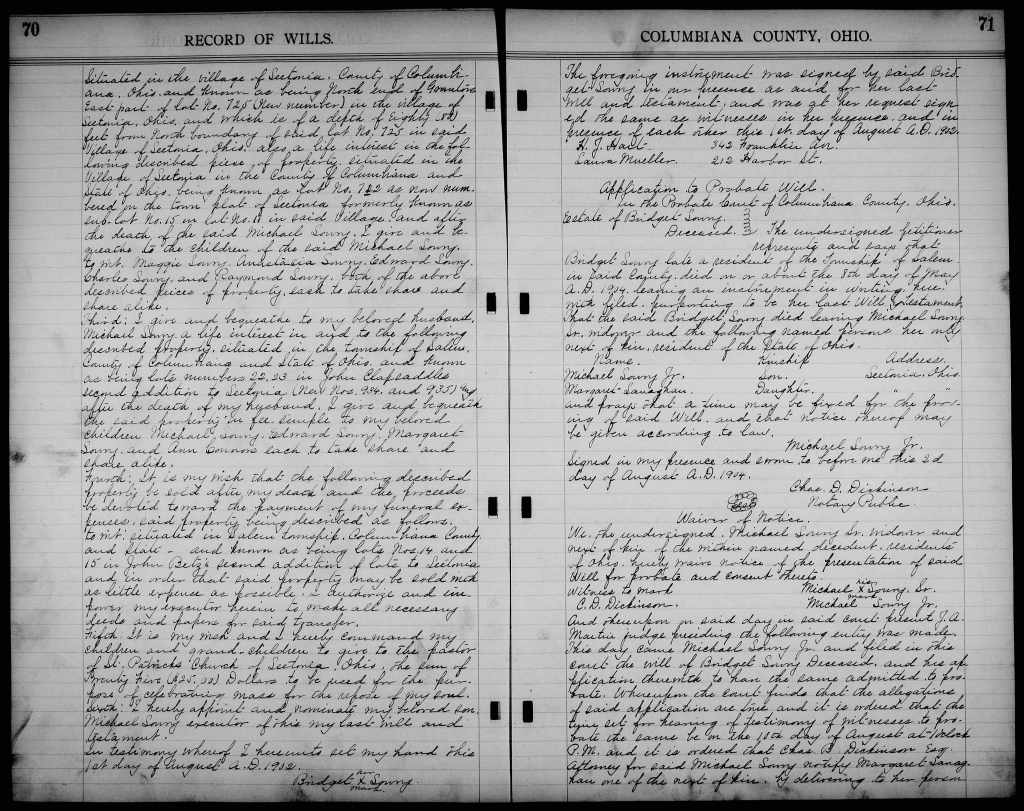
Be it remembered that heretofore to wit: August 6th 1904 came Michael Lowry Jr. and filed in the probate court of Columbiana County, Ohio. The last will and testament of Bridget Lowry, deceased, together with an application to admit the same to probate and a waiver of notice, which will, application and waiver are as follows, to wit:
In the name of the Beloved Father of all. Amen: I, Bridget Lowry of the City of Leetonia, Columbiana County, Ohio, being of sound mind and memory, do make, publish, and declare this to be my last will and testament.
First: My wish is that all my just debts and funeral expenses be paid as soon as after my death as possible.
Second: I give and bequeathe to my beloved son Michael Lowry a life interest in and to the following described property: situated in the village of Leetonia, County of Columbiana, Ohio and known as being North end of [Grancel] East part of lot No. 725 (New number) in the village of Leetonia, Ohio, and which is of a depth of Eighty (80) feet from North boundary of said lot No. 725 in said Village of Leetonia, Ohio. also a life interest in the following described piece of property situated in the Village of Leetonia in the County of Columbiana in the State of Ohio, being known as Lot No. 722 [ed: 712?] as n ew numbered in the town plat of Leetonia formerly known as sub lot No. 15 in lot No. 11 in said village. And after the death of the said Michael Lowry, I give and bequeathe to the said children of Michael Lowry, to wit Maggie Lowry, Anastasia Lowry, Edward Lowry, Charles Lowry, and Raymond Lowry, both of the above described pieces of property, each to take share and share alike.
Third: I give and bequeathe to my beloved husband, Michael Lowry, a life interest in and to the following described property, situated in the township of Salem, County of Columbiana and state of Ohio, and known as being lots numbers 22,23 in John Clapsaddles second addition to Leetonia (New Nos. 934 and 935) and after the death of my husband, I give and bequeath the said property in fee simple to my beloved children Michael Lowry, Edward Lowry, Margaret Lowry, and Ann Connors each to take share and share alike.
Fourth: It is my wish that the following described property be sold after my death and the proceeds be devoted toward the payment of my funeral expenses, said property being described as follows. To wit: situated in Salem Township, Columbiana County, and State – and known as being lots No. 14 and 15 in John Betz’s second addition of lots in Leetonia and in order that said property may be sold with as little expense as possible. I authorize and impower my executor herein to make all necessary deeds and papers for said transfer.
Fifth: It is my wish and I hereby command my children and grandchildren to give to the pastor of St. Patricks Church of Leetonia, Ohio, the sum of twenty-five ($25.00) Dollars to be used for the purpose of celebrating Mass for the repose of my soul.
Sixth: I hereby appoint and nominate my beloved son, Michael Lowry executor of my last will and testament.
In testimony whereof I hereunto set my hand 1st day of August A.D. 1902.
Bridget X Lowry
Her Mark
Source:
Columbiana County, Ohio, Record of Wills, Last will and testament of Bridget Lowry, pg. 69, 6 Aug 1904; “Ohio, Probate Records, 1789-1996,” database with images, FamilySearch (https://familysearch.org/pal:/MM9.3.1/TH-1961-27622-28206-36?cc=1992421&wc=S24N-3TP:266278701,268149001 : accessed 9 Mar 2025), Wills 1903-1905 vol 19-20, image 395 of 658.
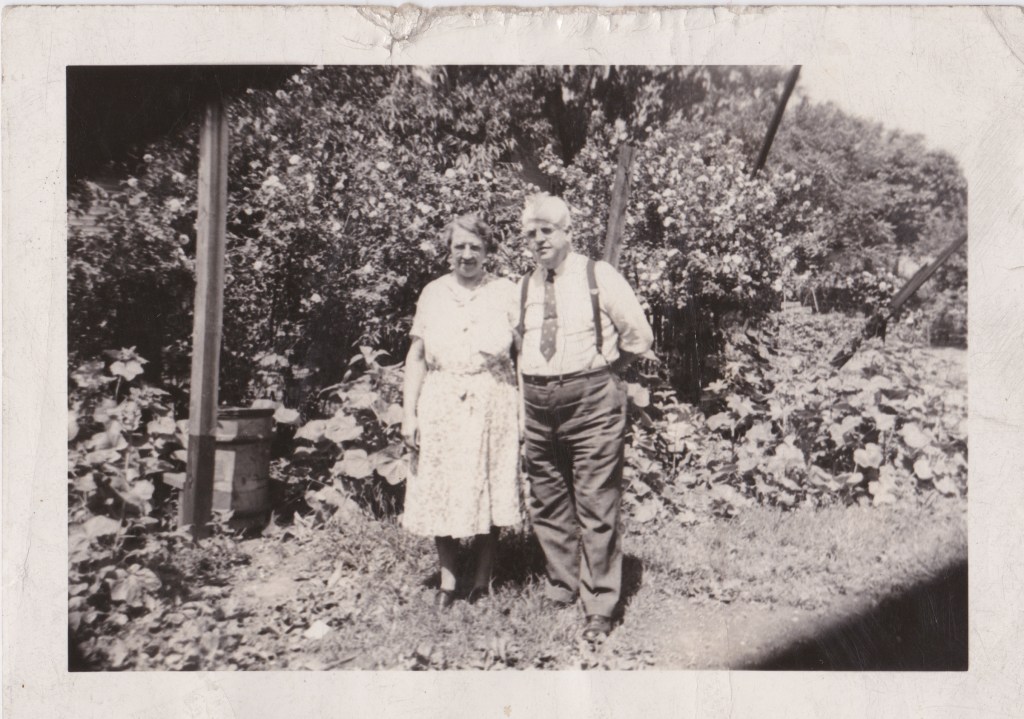
This picture was a draft in my WordPress account titled “Picture of the Day – September 26, 2015.” When I had the idea of sharing this image nearly ten years ago, perhaps I knew who these two people were, but by January 2025, this information was not in my brain. Fortunately, Aunt Mary Catherine Sanders is always willing to share her Witt family knowledge. She replied to a Facebook post:
“The picture is of Eda Witt and her husband, Leo or Leon Lucas. She was the daughter of Mary Elizabeth and Joseph Witt. They took over the grocery store on Ford Avenue as Joe Witt aged. The picture was in their garden. They had no children.“
Eda was my grandfather Howard Witt’s aunt and the oldest sister of my great grandfather, Francis Witt.
Sources:
Eda Witt Lucas and Leo Lucas, photograph, likely taken in the 1940s in their garden at 413 Ford Avenue, Youngstown, Ohio; image taken by unknown photographer; privately held by Joseph Lowry, [address for private use], Sterling, VA. Provenance is Mary Catherine Witt Sanders to Joseph Lowry.
Matt Sanders, personal page, Facebook (https://www.facebook.com/matt.sanders.583/posts/10228231619949915 : accessed 25 Jan 2025), “Posts,” 9 February 2024.
I don’t know if there’s a genetic trait that would show a love of ice cream, but if there is, the Lowrys have it. Maybe it started with my grandfather Chuck Lowry who owned a custard stand starting in the 1940s.

I grew up on the north side of Youngstown, just two blocks from the Dairy Queen at Belmont Avenue and Tod Lane, across from North Side Pool. DQ was always a favorite. Grandpa would, with little to no notice, come pick my sisters and I up and we would pile into his Buick for a trip up the street. Usually my cousins around the corner were already in the car, so it was grandpa and six grandkids (with not enough seatbelts) for the 2 minute ride. He liked to keep things simple. The options were a banana cone, vanilla cone, or a dilly bar. No flurries, Blizzards, or sundaes. We’d get our treats and hang around Dairy Queen or pile back in for the trip home to eat in the driveway. I loved going to that (now closed) DQ on a summer evening. With the pool across the street, there was always a buzz there. I’ve told my wife and parents probably 100 times that there’s no place like that where I live now in Northern Virginia that even comes close.
My uncle Chuck shared a funny story of ice cream with his dad, who, for sake of the story, I should note was diabetic.
I went to 607 from NYC on one trip, and after about five minutes I got the “C’mon, let’s go for a ride.” Of course, after a couple stops, he wanted to go to Handel’s.
“You shouldn’t be eating that stuff.”
“Oh no, the doctor checks my numbers all the time and they are good. He says a cone every week or ten days is no problem, and I haven’t been there for at least two weeks now.”
Of course, I gave in. Later that day, Kathy came by. She talked to dad for a while, and then she came out to the kitchen, where I was fixing dinner. She said, “I feel bad because I let daddy talk me into taking him to Handel’s yesterday.”
He should have been a con man!
I’ll leave the stories there while I get some ice cream from the freezer.

James and Catherine (Travers) Rogan of West North Street in New Castle announced the engagement of their daughter, Miss Kathleen Mercedes [sic] Rogan on Saturday, October 4, 1913. She was a 21-year old salesperson for the New Castle Dry Goods Company upon her engagement to the 31-year old clerk for the Standard Steel Car Company, Noah Groucutt. Noah was the son of George and Bridget (Foy) Groucutt of East Long Avenue, who lived about two miles from the Rogans. Both James Rogan and George Groucutt were tin workers, and very well may have known each other prior to their children meeting.
Noah’s position at Standard Steel Car was indeed a good one. SSC was headquartered in nearby Bulter, Pennsylvania and was a leader in railroad car manufacturing. They manufactured 29,411 railroad cars in 1907. Their New Castle subsidiary, Standard Car Truck, manufactured railroad car components such as wheels and trucks. Standard Car Truck would go on to create the Barber truck, seen on most rail cars even today, and still operates as the Wabtec Corporation.
Kathleen’s role as a salesperson for New Castle Dry Goods was also in a growing business. As the “Lawrence County Memoirs” website states, “The start-of-the-art structure had a modern sprinkler system, drinking fountains, lavish restrooms, a waterproof basement, and various other amenities.” The May 14, 1913, cover story of the New Castle News reads,
“So great was the interest of the people of the city in the new building that crowds were on hand before the opening of the doors at 10 o’clock. Attracted by the beautiful window displays many proceeded from the outside to inspect the handsome new store, which at present occupies the entire first and mezzanine floors. In less than five minutes after the store had been thrown open it was filled with admiring crowds and business was soon underway.”
Noah would eventually leave Standard Steel Car to became an accountant in the local steel mills. Kathleen would become a homemaker, bearing eight children, including my grandmother, Jean Groucutt Lowry.
Note: The article states her middle name as Mercedes, but it was Esther. She had a sister Mercedes, however.
Sources:
“Pennsylvania, U.S., Marriages, 1852-1968,” Ancestry (https://www.ancestry.com/discoveryui-content/view/3999914:61381?tid=113700516 : accessed 10 November 2024) Applications, v· 12 (p· 184-end), 12-15 (p·1-259) no· 10668-13200 1910-1913, Noah Groucutt to Kathleen Rogan, license dated 21 October 1913 and return citing marriage on 21 October 1913; citing Register of Wills Offices of Pennsylvania.
“Rogan-Groucutt Church Wedding,” The New Castle Herald, New Castle, Pennsylvania, 4 Oct 1913, pg 6, col 2; digital images, (https://www.newspapers.com/ : accessed 10 Nov 2024), Newspapers.com.
Joe – Chas – Eddie – Ode [?]

These boys were prowling the mean streets of Salem, Ohio, around 1917 when this image was made. Three of them are known, Joe McSweeney, Chas Lowry, and his brother Eddie Lowry. The man on the right is unknown, with the inscription reading something similar to Ode. McSweeney was Chas and Eddie’s brother-in-law and their sister Anastasia’s husband.
Source:
Joe – Chas- Eddie – Ode [?], photograph, taken in Salem, Ohio, around 1917; digital image, photocopy of original, scanned in 2015 by Joseph Lowry; privately held by Mary Lowry, [address for private use], Canton, Ohio; Four men wearing 1910’s era clothing standing with their hands in their pockets; Provenance is Mary Pepperney Lowry to Charles Lowry to Mary Lowry.
On a snowy Sunday, November 13, 1910, in Dayton, Ohio, John Puhl walked into the National Soldier’s Home. Essentially an early Veterans Affairs hospital, the home provided not just medical care but also short and long-term lodging to veterans, most of the Civil War. As the National Park Service describes, “Requirements for admission were that soldiers had been honorably discharged from military service and that they had contracted their disabilities during the war. Men admitted themselves to the home voluntarily and could request a discharge. The homes were run in a military fashion: men wore uniforms and were assigned to companies; bugles and cannons signaled daily schedules. The homes provided schools, churches, hospitals, and gardens thought to be therapeutic for the veterans.”
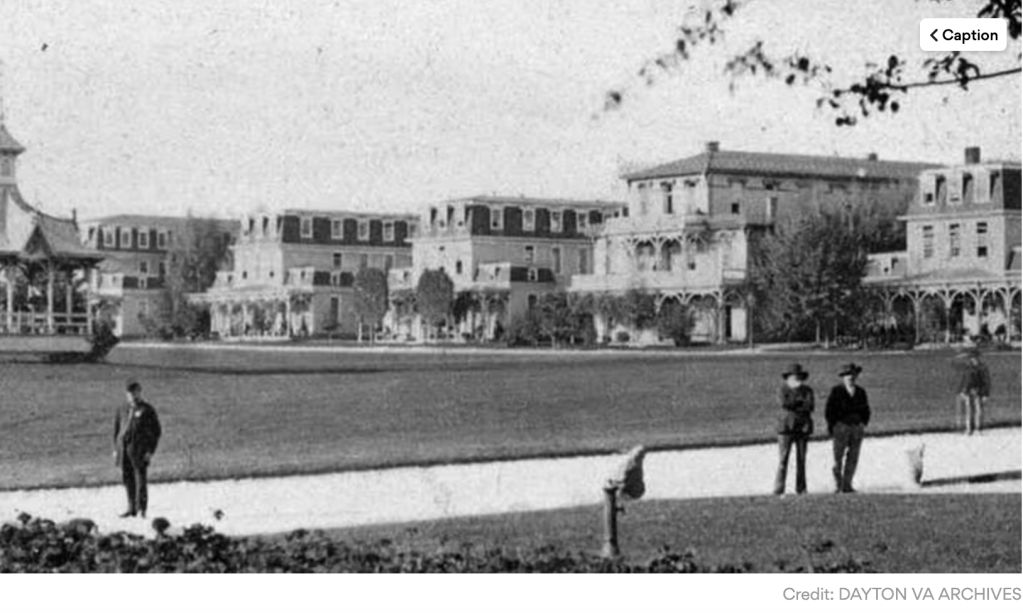
It’s likely that John signed in that Sunday for medical care. His wife Emma was still living in Pittsburgh, so it’s doubtful he initially intended to live there for the rest of his life, although he could have if he wished. The intake form states Emma lived at 2621 Linwood Avenue in Pittsburgh (until 1907 the independent city of Allegheny) in the Pleasant Valley neighborhood, at the time an enclave of German, Irish, Italian, and Polish families primarily living in single-family homes. The form fails to capture that they lived with eight others in the home of their daughter Ida and son-in-law (and Major League baseball player) Augustus Dundon, their three children, and Ida’s siblings Harry, Bertha, and Grace. John was a molder in an iron foundry, a typical job in Pittsburgh’s booming steel and iron industry.
John’s intake form states that he was 5 foot, 5 inches and had “effective hearing and vision, old injury to left hip with about 1/2 inch shortening of the leg accordingly, G.S.W left shoulder, cardiac hypertrophy, arteriosclerosis, dermal condition good.” While most of those ailments are representatives of the diet and medical condition of most men his age, the G.S.W. – gunshot wound – could represent a Civil War injury and the needed disability to be seen for care in the National Soldier’s Home.
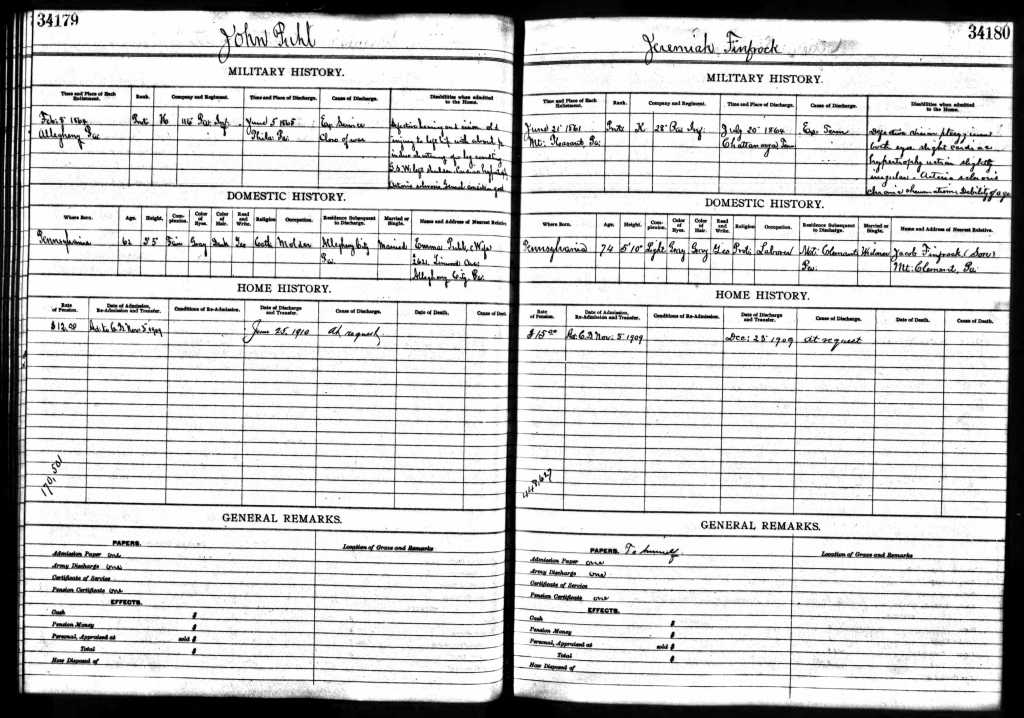
John stayed in Dayton for seven months, checking himself out on June 25, 1910. According to available records, he did not return to Dayton for further treatment. He died in Pittsburgh in 1916.
Editor’s Note: John Puhl is the older brother of Margaret Puhl Pepperney (1849 – 1923). Margaret is the wife of Frank Pepperney (1847 – 1927) and mother of George P. Pepperney (1871 – 1962).
Sources
1910 U.S. census, Allegheny County, Pittsburgh, population schedule, tract X4, enumeration district (ED) 629, sheet 1B, dwelling 17, family 18, household of August Dondon; digital image, Ancestry.com (http://www.ancestry.com : accessed 3 Feb 2024); FHL microfilm 1375321, citing NARA publication T624, roll 1308.
“An Atlas of the North Side: Pleasant Valley Neighborhood Area of Pittsburgh 1977,” Pittsburgh Neighborhood Alliance, 1977; University of Pittsburgh Center for Urban and Social Research, site search “Pleasant Valley,” (https://web.archive.org/web/20120415121104/http://www.ucsur.pitt.edu/files/nrep/1977/north%20side%20pleasant%20valley%20PNA%201977.pdf : accessed 3 February 2024).
Larue, Paul, “A Nation Repays Its Debt: The National Soldiers’ Home and Cemetery in Dayton, Ohio (Teaching with Historic Places),” National Park Service, 2003-2004, (https://www.nps.gov/articles/a-nation-repays-its-debt-the-national-soldiers-home-and-cemetery-in-dayton-ohio-teaching-with-historic-places.htm : accessed 3 February 2024).
“Pennsylvania, U.S., Veterans Burial Cards, 1777-2012,” digital images, Ancestry.com (https://www.ancestry.com : accessed 3 Feb 2024), entry for John Puhl; citing Pennsylvania Veterans Burial Cards, 1929-1990, Series 1, Folder No. 393, Pennsylvania Historical and Museum Commission, Harrisburg, Pennsylvania.
Register of Members, Entries 33000-34499, to the National Soldier’s Home at Dayton, Ohio, John Puhl, 34178, image 613 of 786; U.S. National Homes for Disabled Volunteer Soldiers, 1866-1938; Ancestry.com, Provo, Utah, Ancestry.com Operations Inc, 2007.
“Weather Forecast,” Dayton Daily Herald, 12 Nov 1910, pg 1, masthead; digital image, (https://www.newspapers.com : accessed 3 Feb 2024), Newspapers.com.
In the annals of warfare, few units are as storied as the American Eighth Air Force during World War II. It’s estimated that 350,000 men served in the Mighty Eighth during the war. One of them was Lt. Francis Witt, assigned to the 384th Bombardment Group as a pilot of a B-17 Fighting Fortress. With a crew of 10 men, up to 13 machine guns, and a typical bomb load of 4,000 pounds, she was the backbone of the European strategic bombing campaign against Germany.
After flight training in the United States, Witt arrived in June 1943 at United States Army Air Field 106, more popularly known as RAF Grafton Underwood, outside Kettering, Northamptonshire, England. Grafton Underwood, before World War II, was largely farmland, but the Nazi invasion of France in 1940 and the subsequent bombing of England meant additional airfields were needed to first launch aircraft to defend Britain and then offensively strike targets throughout the European continent. Initially assigned a Royal Air Force squadron, Grafton Underwood was one of a number of bases turned over to the Army Air Force beginning in 1942 after the United States joined the war. (In fact, RAF Grafton Underwood launched the first USAAF bombing mission against the Nazis when then-Captain Paul Tibbets, later known for dropping the atomic bomb on Hiroshima, led a bombing mission against a train yard in Rouen, France.)

Although he arrived at Grafton in June 1943, an accident while landing during a training flight kept Francis grounded until October. It was just as well, anyway. September and October 1943 represented a rebuilding period for the B-17 groups in England. Two August 17 raids to bomb the industrial cities of Schweinfurt and Regensburg in Germany had cost 60 of the 376 participating bombers. With an average crew of ten, that represented over 600 aircrew killed or missing in action. While Francis didn’t fly this mission, his 384th Group lost five of the 20 planes that launched to enemy action. So while the missions continued after – bombing runs to submarine pens in France and German airfields in Belgium – none included as many aircraft or were as complicated an operation as the August 17 mission.
That would change on October 14 when the 8th Bomber Command, the bombing arm of the famous 8th Air Force, identified the ball bearing plants of Schweinfurt as once again needing to be bombed. The mission was theoretically simple. A massive armada of American bombers would fly to Schweinfurt and, at the appointed moment, drop their bombs over the target. Anyone who has seen the films 12 O’Clock High or Memphis Belle, however, knows it’s not that simple. Aircrews faced murderous and accurate flak from the ground and German fighters numbering in the hundreds. Meanwhile, American “little friends,” as the P-47 Thunderbolts were called by the bomber crews, lacked enough fuel to go all the way to the target. As soon as they departed, the German fighters jumped. The aircrews knew the odds for their return were never great.
On the morning of the 14th, Francis was likely asleep in his steel Nissen hut with seven other officers when an enlisted man came to wake him up. “Good morning, sir; you’re flying today as co-pilot for Flight Officer Carter in ship 525, What’s Cookin’ Doc. Breakfast at 0800. Briefing at 0845.”
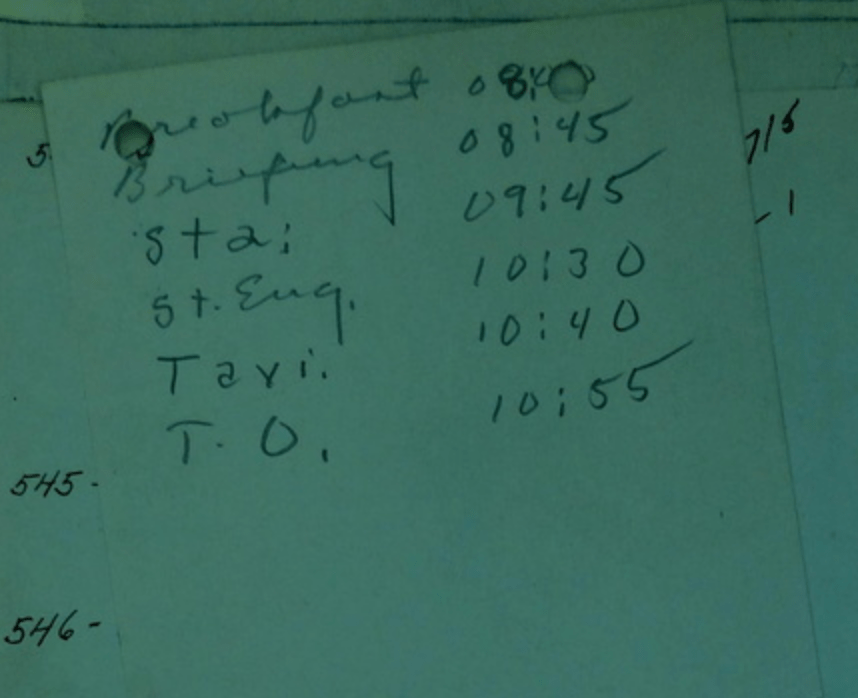
As the officers filed into the briefing room, there was a curtain covering the location to be bombed, but as the briefing started and the curtain was removed, audible groans would have gone up as “SCHWEINFURT” was announced. The men in the room all knew what happened last time. The briefing would have provided the operational details of the mission. An operations officer would have given the flying route, the levels of enemy flak and aircraft expected, and the secondary targets available if weather socked in the primary. A meteorological officer would have briefed the expected weather conditions. The Group’s chaplain was likely hanging out in the back or just outside the briefing room to bless the airmen as they exited or provide one last absolution before going up and maybe not coming back. Then, piling into a jeep, the men were carted to the other side of the airfield to the fleet of waiting B-17s sitting on the hardstands. Greeting the crew chief, Carter and Witt were briefed on any mechanical issues he had to troubleshoot or repair overnight.
The crew for the mission was:
| Pilot | Carter, T L |
| Co-pilot | Witt, Francis John, Jr |
| Navigator | Garrison, Keith M |
| Bombardier | Smith, Harvey Daniel |
| Radio Operator | Benson, Thomas Joseph |
| Engineer/Top Turret | Treat, Royal DeWitt |
| Ball Turret | Connelly, Gordon Raker |
| Tail Gunner | Pastorella, John Paul |
| Waist (Flexible) Gunner | Barto, Louis Joseph |
| Waist (Flexible) Gunner | Hubbard, Warren Emmett |
At 1030, it was “start engines,” and the airfield came to life as three squadrons worth of aircraft, twenty-one in all, sputtered, spurted, and then roared with the spinning of 84 Wright Cyclone engines. Taxiing en masse and taking off less than a minute apart, the whole fleet of 384th bombers would be airborne in about 20 minutes. The 384th bombers would join up with the other groups in the skies of southeast England, with 291 aircraft in all heading to Schweinfurt in an attempt at crippling the German ball bearing production.
The B-17 flying over England would form “combat boxes” in the sky to ensure a tight formation but allow each bomber the space to drop its load unencumbered. Francis’s B-17 was flying in the high group for the Schweinfurt mission. This was always the preferred spot in the box; lower groups tended to make for easier targets for enemy aircraft and flak.


The 291 bombers flying to Schweinfurt that day relied on their escort fighters for protection, but the P-47 fighters departed their bigger cousins after about 200 miles. From bases all over France, Belgium, and Germany, the Luftwaffe struck with the typical tactic employed of German fighters flying directly at the bombers. They would lay a short burst of close, murderous fire right where it would cause the most harm – into the pilots. Bombers would fall from the sky with their dead pilots as the remaining eight members of the aircrew attempted to fight the G forces of an out-of-control aircraft and jump before the plane exploded into the ground. After the German fighter ran head-on into the bombers, they’d come back from behind, firing explosive rockets into the formation. While inaccurate, a single lucky strike could take down a bomber or, at worst, force the formation to take evasive action, separating them and making them more susceptible to gunfire.
All of this hell unfolded in front of Francis as he and Carter guided their B-17 over the target. After “bombs away,” it was a sharp turn to the right and a small slice of hope they make it home. The enemy aircraft and flak, however, would remain for 200 miles of the return. Only over Belgium would the P-47s return to provide cover for the last leg home. The odds were stacked against the crews as rain and low cloud cover typical of England in the winter socked in Grafton Underwood. Many of the 384th planes couldn’t find the airfield. Three planes were lost, and their crews bailed when they started running out of fuel. Carter and Witt would not make it back to Grafton, taking What’s Cookin’ Doc and the eight other men inside it to RAF Little Staughton, a B-17 repair depot.
Sixty of the 291 bombers that launched for Schweinfurt were lost to enemy action. Another dozen were scrapped due to damage. Six hundred men were captured or killed in action. In Witt’s 384th Group, six aircraft went down. Lt. William Harry’s B-17, ME AN’ MY GAL, was shot down by German aircraft. His co-pilot and bombardier were killed, while Harry and seven others were captured as POWs. In the ship flown by Lt. Lawrence Keller, Sad Sack, everyone in the front of the aircraft – the two pilots, navigator, bombardier, radio operator, plus the ball turret gunner, were killed, likely victims of the German head-on assault. Four men jumped in their chutes to become POWs. Lt. William Kopf’s The Joker exploded over Belgium, with seven killed. Lt. Giles Kauffman’s B-17, Big Moose, went down near Brückenau with nine POWs. A gunner, Sgt. Peter Seniawsky, evaded capture and made it back to England. Lt. Walter Williams and Lt. David Ogilvie’s crews were fortunate. Of the twenty men, only one was killed. Nineteen either evaded capture or spent the rest of the war as POWs.
As historian Donald L. Miller would later write in Masters of the Air, a comprehensive study of the Eight Air Force in World War II (and soon-to-be AppleTV+ miniseries), “The deep penetration raids against Schweinfurt’s ball bearing complex should not have been mounted until a larger bomber force was assembled and protected by long-ranger fighters. In miscalculating the ability of the unfortunately named Fortress to stand up to the Luftwaffe, American air planners needlessly sacrificed the lives of young men who were unable to fully appreciate the desperate nature of their missions.” (p. 469)
Sources:
This article could not have been completed without the resources, images, and databases of the 384th Bomb Group, Inc.
384th Bombardment Group Association, Inc., (https://384thbombgroup.com : accessed 13 Jan 2024), used the mission profiles, crew profiles, and images databases.
““Black Thursday” October 14, 1943: The Second Schweinfurt Bombing Raid,” The National World War II Museum, (https://www.nationalww2museum.org/war/articles/black-thursday-october-14-1943-second-schweinfurt-bombing-raid : accessed 13 Jan 2024).
Blackwell, Wally, “398th Bomb Group Combat Formations,” 398th Bombardment Group Memorial Association, Inc., (http://www.398th.org/Research/8th_AF_Formations_Description.html : accessed 13 Jan 2024),
“Combat Box,” Wikipedia, (https://en.wikipedia.org/wiki/Combat_box : accessed 13 Jan 2024).
“Little Stoughton,” Bomber Command, Ministry of Defence, (https://web.archive.org/web/20121026084305/http://www.raf.mod.uk/bombercommand/s101.html : accessed 13 Jan 2024), Wayback version of website, version updated 6 Apr 2005, 2:40 AM.
Miller, Donald L. “Masters of the Air: America’s Bomber Boys Who Fought the Air War against Nazi Germany,” Simon & Schuster, 1st printing, New York, 2006.
 lowry genealogy