Military Monday – John Pepperney at the Third Battle of Winchester

In the late summer of 1864, Confederate General Jubal Early marched his men up the Shenandoah Valley of Virginia, with Union General Philip Sheridan and his Army of the Shenandoah not far behind them. The concern for the Union Army was that if Early went unchecked, he had an easy path down the Potomac River using the nearby railroads to force his way into Washington, D.C. With the 1864 presidential election not far away, and political catastrophe for Lincoln if Early got close to Washington, Sheridan knew he had to stop him.

One of the men in this Army, under Wright’s VI Corps, Getty’s Division, Wheaton’s Brigade, the 139th Pennsylvania Infantry and finally D Company, was my great grand uncle John Pepperney of Pittsburgh, Pennsylvania.

John was born in Prussia on 15 January 1845 to Jacob and Anna Maria Krotterin Pepperney. He arrived in America around 1852 and his family settled in Reserve Township, Allegheny County, Pennsylvania. John was inducted into the Federal army on 1 September 1862 when he was 17 years old. The 139th Infantry was comprised of men from Allegheny County. Many of them were no doubt immigrants like John who either volunteered or were drafted to fight for their new country.

Within two days of being organized, the 139th Infantry found itself in Manassas, Virginia where it buried the bodies of the men killed at the Battle of Second Manassas. It was no doubt a grisly welcome to the army and made the reality of what was in front of them very real. The official summary of service of the Pennsylvania regiments tells this tale well:

After that, John and the 139th found themselves confronted by the enemy in battles we know well from history books. Antietam. Fredericksburg. Chancellorsville. Maryes Heights. Gettysburg. Wilderness. Spotsylvania. Cold Harbor. Petersburg. That John made his way through the hell of those battles unscathed is a miracle. That is, until he arrives near Winchester, Virginia on the evening of 18 September 1864.

At 3 a.m. on 19 September, General Sheridan launched his attack on Early’s men from the north, pushing his leading forces back into Winchester. This early action by cavalry allowed Sheridan to organize his infantry forces marching from Berryville to the east.

Company D of the 139th Infantry was square in the center of the VI Corps assault on the Confederate lines. To their right were no fewer than 13 Union brigades while to their left just General Daniel Bidwell’s brigade held the end of the line. With cannon fire shooting over their heads, the 139th Infantry advanced down the Berryville Road. They entered into Winchester as the Confederates pulled out, leading a retreat to Strasburg, 20 miles to the south. It was during this action that John was wounded. What caused this injury remains unclear, but the muster rolls of the 139th Infantry state he was injured on this date and at this place. Still, his injury was minor enough to keep him with the Army. John Pepperney would continue with the 139th Infantry through the remainder of the war and was mustered out of service on 21 June 1865.

The interchange of Interstate 81 (north and south) and Route 7 (east and west) in Winchester, Virginia. It was just a few hundred feet to the south of the interchange where the 139th Pennsylvania advanced on the Confederate troops on 19 September 1864.

The Third Battle of Winchester was the bloodiest battle in the Shenandoah Valley Campaign of 1864 and effectively pushed the Confederate army out of this part of Virginia.

Sources:
Bates, Samual. “History of Pennsylvania Volunteers, 1861-5; Prepared in Compliance with Acts of the Legislature, by Samuel P. Bates.” Making of America. University of Michigan, 1 Jan. 1869. Web. 23 Mar. 2015.

“139th Regiment of the Pennsylvania Civil War Volunteers,” Pennsylvania Volunteers of the Civil War, (http://www.pacivilwar.com/ : accessed 28 Nov 2020), article on the 139th Infantry.

“Third Battle of Winchester.” Civil War Trust. Civil War Trust. Web. 23 Mar. 2015.
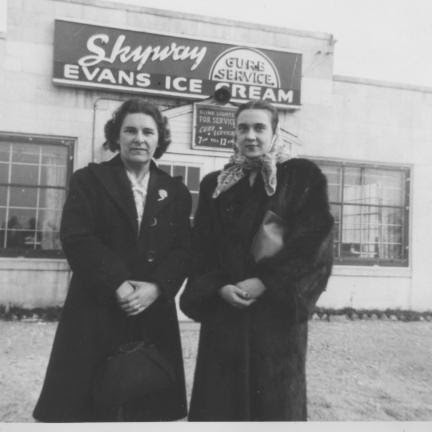
Photo of the Day – March 23, 2015

I can’t put a specific date or location on this photo, but my grandmother Jean Groucutt Lowry and her mother-in-law Margaret Pepperney Lowry look to be on a road trip. They probably stopped for gas or a quick bite to eat and one of their husbands asked for a quick photo. Neither looks particularly happy to be posing for the camera.
Source:
Mary Margaret Pepperney Lowry (1902-1980) and Jean Groucutt Lowry (1924-1986), photograph, taken at unknown location, in late 1940s; digital image, photocopy of original, scanned in 2013 by Joseph Lowry; privately held by Mary McCaffrey, [address for private use], Canton, Ohio. Two women standing in front of a restaurant. Provenance is Charles Lowry to Mary McCaffrey.

Photo of the Day – March 22, 2015

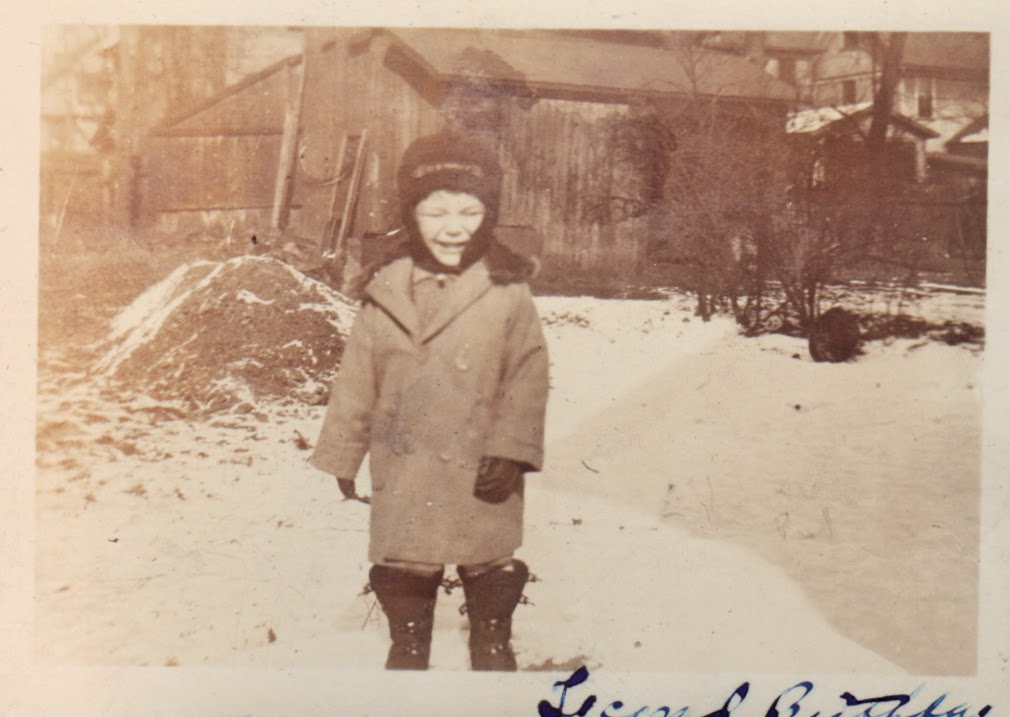
A bright smile and closed eyes greeted my great grandmother when she took this photo on her son’s second birthday. She no doubt wanted a photograph to help remember his big day, but anything taken indoors probably wouldn’t have developed properly. Thus, it was time to bundle up and take little Charles outside for the shot. The more I look at this collection of photos, the more I love the idea of her carrying her camera around, capturing all sorts of images of her son.

Source:
Charles James Lowry (1924-2007), photograph, taken at unknown location, in November 1926; digital image, photocopy of original, scanned in 2013 by Joseph Lowry; privately held by Mary McCaffrey, [address for private use], Canton, Ohio. Portrait of toddler in winter coat and hat standing in snowy yard. Provenance is Charles Lowry to Mary McCaffrey.

Photo of the Day – March 20, 2015

In honor of the Notre Dame men’s basketball team barely squeezing out a victory over Northeastern University in the men’s tourney yesterday, I give this you image of Our Lady’s University. The golden dome atop the Administration Building is one of the most recognizable university symbols in the country. My grandfather Charles Lowry took this photo during a trip to Notre Dame in November 1941. You can see more photos from that trip on this post.

Source:
The Administration Building at the University of Notre Dame, photograph, taken on either 21 or 22 November, 1941; digital image, photocopy of original, scanned in 2013 by Joseph Lowry; privately held by Mary McCaffrey, [address for private use], Canton, Ohio. Provenance is Charles Lowry to Mary McCaffrey.


Photo of the Day – March 19, 2015

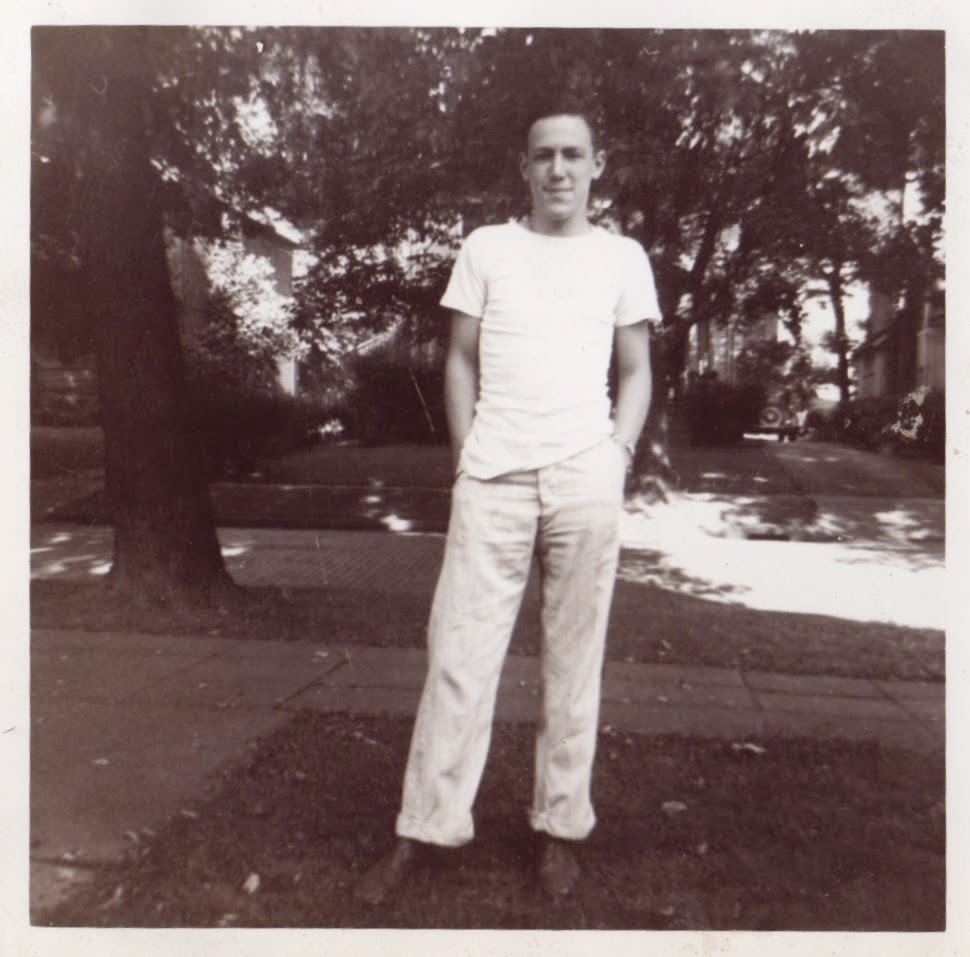
My grandfather Charles Lowry is posing in this photo looking dapper in a double breasted jacket and white tie. I seem to recall other similar photos indicating that this his 8th grade graduation in the spring of 1938 or 1939. The timing is right, as I think the little girl is is his first cousin Catherine Pepperney who was born in 1937 and would be 1 or 2 years old.

Source:
Charles James Lowry (1924-2007) and believed to be Catherine Pepperney Campana, photograph, taken at unknown location around 1939; digital image, photocopy of original, scanned in 2013 by Joseph Lowry; privately held by Mary McCaffrey, [address for private use], Canton, Ohio. Young man in dark blazer and white shirt and white pants standing in front of young child on small bike. Provenance is Mary Pepperney Lowry to Charles Lowry to Mary McCaffrey.

Photo of the Day – March 18, 2015

My great uncle Francis Witt Jr. married Mary Lou Murray on August 2, 1944. Shown in this photo on their wedding day are Francis’s younger brother Howard (my grandfather) and the baby of the family, his sister Helen. It is unknown to me who the woman on the right is. Less than a week prior Francis had returned home to Youngstown after being reported missing in action. According to a Vindicator report, how he arrived home was not disclosed (but I can let you in on the secret).

Source:
Unknown, Mary Lou Murray Witt (1917-2001), Helen Witt (1934-2009), Francis Witt Jr. (1920-2002) and Howard Witt (1929-2001), photograph, taken at unknown location on 2 Aug 1944; digital image, photocopy of original, scanned in 2013 by Joseph Lowry; privately held by Marie Dockry, [address for private use], Austintown, Ohio. Three women and two men, one in a service uniform, appearing for a wedding. Provenance is Marie Dockry to Joseph Lowry.

Photo of the Day – March 17, 2015

Joseph McSweeney was just 11 months old when his mother Anna Lowry McSweeney died of cancer in March 1920 at the age of 24. Anna was the sister of my great grandfather Charles E. Lowry. After that, young Joseph was raised by his grandparents Michael and Anna Lowry in Salem, Ohio. He died in 1979 in Rehoboth Beach, Delaware.

Source:
Joseph McSweeney (1918-1979), photograph, taken at unknown location around 1920; digital image, photocopy of original, scanned in 2013 by Joseph Lowry; privately held by Mary McCaffrey, [address for private use], Canton, Ohio. Young boy, approximately two years old, standing in front of Model T car. Provenance is Mary Pepperney Lowry to Charles Lowry to Mary McCaffrey.

My DNA Says I Am From Where?!

DNA tests can reveal new ancestors, show your ethnic breakdown and solve genealogical mysteries that would otherwise go unanswered. A problem arises when the same genetic material gives you two different answers to one question:
Where Am I From?
Trying to figure you where you came from historically and genetically is much simpler than it was a decade ago. Several companies offer DNA tests that include ethnicity estimates. These estimates are created by analyzing your genetic material (just a small amount of saliva) and comparing it to thousands of others. While realizing they are only estimates, they provide a little more truth to statements such as, “I’m 50% Irish, 30% German and 20% English,” or whatever you’ve always believed your ethnic breakdown to be. Keeping in mind that these are estimates and that Europe is as much of a melting pot as America can lead to some interesting statistics.
I wrote about a DNA test that my father took a few months ago through Family Tree DNA. I recently took a DNA test of my own through AncestryDNA, another company that offers tests as part of their genealogical product offering (the parent is Ancestry.com). Included in my results was the ethnicity estimate. AncestryDNA writes that they calculate their ethnicity estimates this way:

We create estimates for your genetic ethnicity by comparing your DNA to the DNA of other people who are native to a region. The AncestryDNA reference panel (version 2.0) contains 3,000 DNA samples from people in 26 global regions. 

We build the reference panel from a larger reference collection of 4,245 DNA samples collected from people whose genealogy suggests they are native to one region. The images below show the process of gathering local samples from various parts of the world. 

Each panel member’s genealogy is documented so we can be confident that their family is representative of people with a long history (hundreds of years) in that region.
Each volunteer’s DNA sample from a given region is then tested and compared to all others to construct the AncestryDNA reference panel. In the end, 3,000 of 4,245 individuals are chosen for the AncestryDNA reference panel (version 2.0). These individuals make up 26 global regions.

We then compare your DNA to the DNA in the reference panel to see which regions your DNA is most like. The ethnicity estimate you see on the web site is the result of this comparison. When we calculate your estimate for each ethnicity region, we run forty separate analyses. Each of the forty analyses gives an independent estimate of your ethnicity, and each one is done with randomly selected portions of your DNA. Your genetic ethnicity estimates and likely ranges for these estimates come from these forty analyses.[1]

With all of that in mind, I was excited to see my breakdown and learn if it matched my research. That research would indicate that I’m at last 60% German, 25% Irish, and 15% English. Keep in mind this is only going back 5 generations on average; going back any further is rather complicated because of the number of grandparents and the gaps in research. Much to my surprise, it was nowhere close!
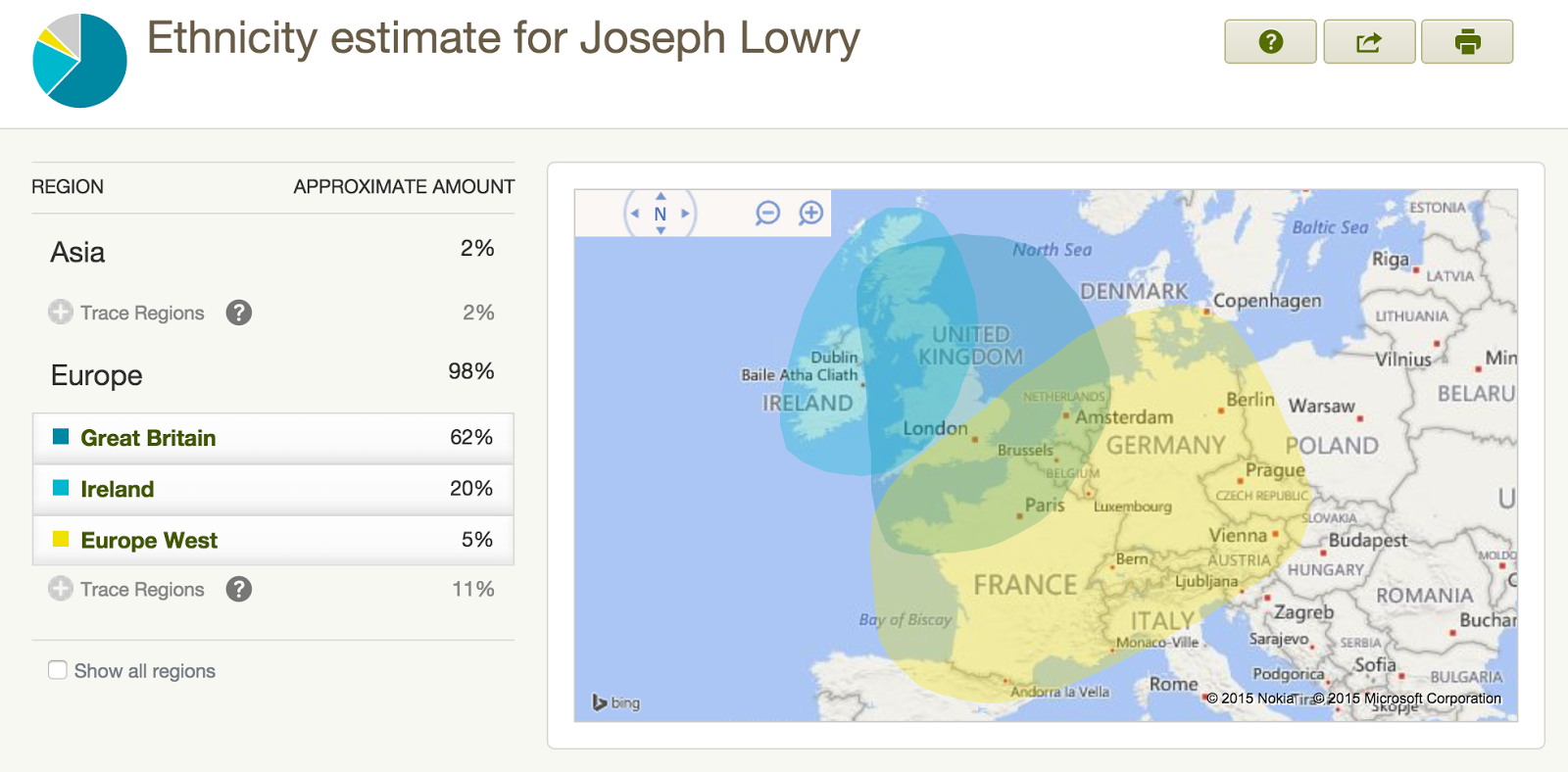
My AncestryDNA estimate indicates that I am 62% descended from Great Britain, 20% Ireland and only 5% from Western Europe. WHAT?! Where are my Germans?! I have German surnames including Bahle, Witt, Bixler, Governor, Porubsky, Schulmeister, and Pepperney (Anglicized in a few cases) in my family history and they are getting almost no recognition by my saliva!
My ethnic matches from AncestryDNA’s autosomal DNA test. (click to enlarge.)
I was a bit stunned by the results but realize that over centuries people move. These results aren’t meant to capture a single moment in time but ancestral makeups throughout history.
Once I had my AncestryDNA results, I actually transferred my raw DNA data to Family Tree DNA. They have a service that takes the raw data from another company and uses their algorithms to produce an ethnicity report. After only a few days (since they only had to analyze the data and not test saliva), I had my results based on their algorithm.
According to Family Tree DNA, they calculate their estimates based on the following, in part, and with a bit more science in the explanation:

We assembled a large number of candidate reference populations which were relatively unadmixed and sampled widely in terms of geography. From these we removed related or outlier individuals with the Plink software, utilizing identity-by-descent (IBD) analysis and visually inspecting multi-dimensional scaling plots (MDS). Further visualization established that the reference population sets were indeed genetically distinct from each other. We also ran Admixture and MDS with specific populations to asses if any individuals were outliers or exhibited notable gene flow from other reference groups, removing these. Admixture was run on an inter and intra-continental scale to establish a plausible number of K values utilizing the cross-validation method [Alexander2011]. After removing markers which were missing in more than 5 percent of loci and those with minor allele frequencies below 1 percent, the total intersection of SNPs across the pooled data set was 290,874. The final number of individuals in was 1,353. 

To validate our Reference Population set we tested them against a list of well studied benchmark groups whose ancestral background in the literature has been well attested. Additionally we also cross-checked against individuals with attested provenance within the GeneByGene DNA database.[2]

So both companies test their results against certain population groups who they believe have remained relatively static over time. Still, once I checked my result, I was again surprised and this time for entirely different reasons.

My ethnic makeup according to Family Tree DNA. (click to enlarge.)
My Family Tree DNA estimate indicates I am 42% British Isles (Great Britain and Ireland), 30% Scandanavian, and 26% from Southern Europe. A mere 2% Central Asian is a statistical anomaly that I discount. So what does this imply? It’s certainly very different from my AncestryDNA results. It too fails to properly represent my presumed Germanic background. Neither result indicates anything close to the percentages I had assumed based on my research.
This raises so many more questions than it answered. It is forcing me to dig deeper and cast a wider net than I previously imagined in search of the truth of where I come from. I also realize these are simply estimates based on a small bit of saliva. If the tests were run again, the results could be slightly different. Genetic genealogy is a new field for me, and one that I am eager to continue exploring. I plan to share more of these discoveries in future posts!

Sources:
Ball, Catherine A., Mathew J. Barber, Jake K. Byrnes, Josh Calloway, Kenneth G. Chahine, Ross E. Curtis, Kenneth Freestone, Julie M. Granka, Natalie M. Myres, Keith Noto, Yong Wang, and Scott R. Woodward. “Ethnicity Estimate White Paper.” Ancestry.com (2013): n. pag. 30 Oct. 2013. Web. 17 Feb. 2015.

Khan, Razib, and Rui H. “MyOrigins Methodology Whitepaper – FTDNA Learning Center.” FTDNA Learning Center. Family Treee DNA, 8 May 2014. Web. 17 Feb. 2015.