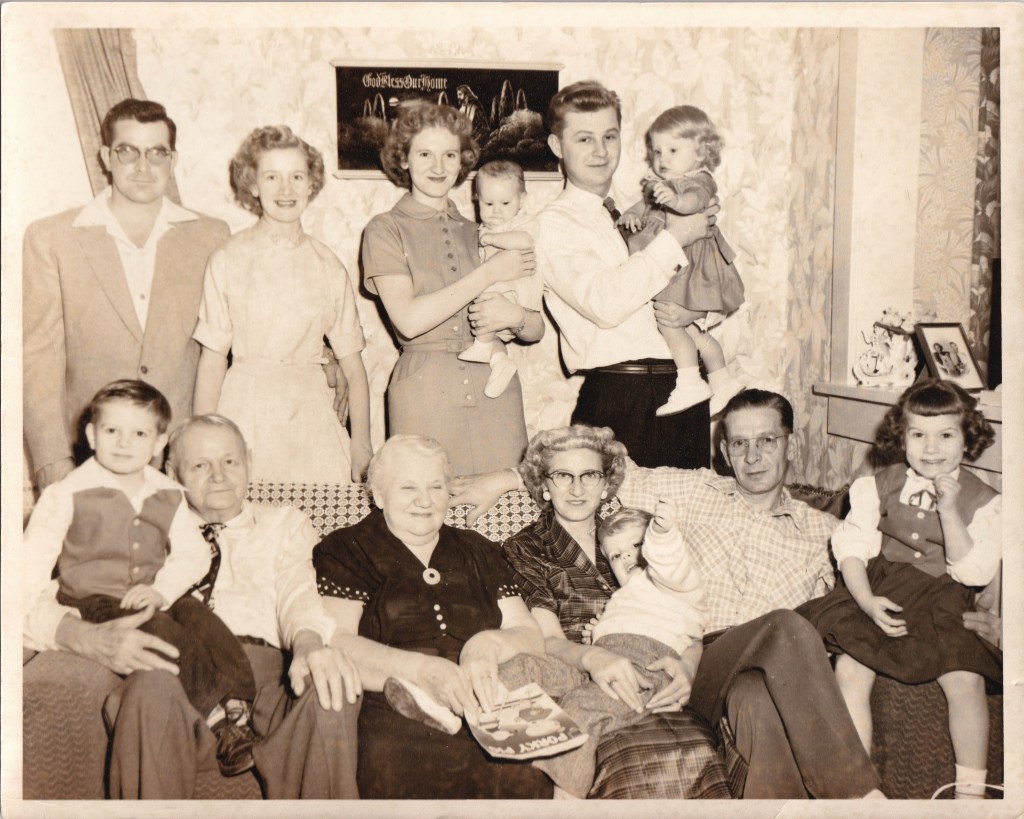
The Wolfords in February 1957

I’ve recently been given a large collection of Witt family photos to scan, and among them is this gem. This photo shows four generations of Wolfords, Witts, and Thomas’s. The back of the photo reads:

Taken Feb 1957
Family group of children, grandchildren, and great-grandchildren of
Mr. and Mrs. Carl Porubsky
1015 N. Madison St
Topeka, Kans.

Front Row: Danny Thomas, Carl Porubsky, Elizabeth Schulmeister Porubsky, Caroline Porubsky Wolford, David Witt (in Caroline’s lap), Raymond Wolford, Diane Thomas

Back Row: Walt Thomas, Betty Wolford Thomas, Barbara Wolford Witt (holding Rebecca Witt), and Howard Witt (holding Julie Witt)

Source:
Family photo of Carl and Elizabeth Porubsky, Raymond and Caroline Wolford and their children and grandchildren, photograph, taken at 1015 N. Madison St., Topeka, Kansas, in February 1957; digital image, photocopy of original, scanned in 2026 by Joseph Lowry; privately held by Rebecca Lowry [address for private use], Poland, Ohio; Family group sitting on a couch or standing behind it in a living room setting; Provenance is Barbara Witt to Rebecca Lowry.

The Porubskys from Russia to Topeka

The text below was provided by my grandmother, Barbara Witt Viti, as a photocopy of a document titled “The Origin of the German Russian People.” This three-page document summarizes the Porubsky genealogy and was likely typed in the mid to late 1980s. Based on the memories shared, the narrative style, and the focus on Carl Porubsky, I believe this was written by my great-grandmother, Caroline Porubsky Wolford. I have copied the text here exactly as it appears with no edits. It’s a fascinating read into the life of the Volga Germans living in the “Little Russia” neighborhood of Topeka, Kansas.

Page 1:

THE ORIGIN OF THE GERMAN RUSSIAN PEOPLE

About 250 years ago, Catherine of Russia, who was of German birth, wanted to bring better farming to Russia, and made a deal with a group of German farmers who were dissatisfied with the military. She promised if they would move to Russia they would be given free land and freedom from taxes and military service. They settled along the Volga taking with them seed for the wheat they grew so successfully through good farming, their thirst, their lose of peace. It was probably one of the most unusual interludes ever known in human living. Freedom from war, debt and taxes. The Germans did not intermingle with the Russians nor learn the language. They kept their own customs and brought their children up in the ways and speech of their own country. There were a little Germany inside the Russian borders. After Catherine’s era, conditions changed for the little colony. They were being taken for the military, the same as they had been in Germany. After long deliberation and mixed emotions, Mathius Porubsky, his wife Christina and 5 children decided to come to America. There was much sadness in leaving their parents and remaining sisters, brothers and relatives they possibly never see again and most families did not. The families described the feelings as a living death.

The year 1900, the Porubsky’s boarded ship and sailed rough ocean waters for 21 days. Most people became sea sick. The weather was cold, and the water of the 21 days on ship were very bad. They landed in Baltimore, Maryland and needles to say their happiness was great to be able to set foot on American soil. Most of the people kneeled down and gave thanks with eyes and clasped hands raised to heaven.

Addundum: They left Bramin [Bremen] Germany, and boarded the S.S. Roland Ship. The Porubsky family came directly to Topeka. A family of distant relatives had come to Topeka, established their home and sent them money for passage. The cost of the passage for the family was $253.00. The Porubsky family lived in the home of these people until they could establish a home of their own. Carl was 15 years old and the oldest of the children, Matthew was a small baby. The father of the family felt a heavy responsibility on his shoulders. New country, no home, no work and a debt to repay. He soon found farm work. Carl worked along his father to help provide for the family. The younger children were sent to school. Carl received little schooling but became educated in his own right and trades he learned later in life. Father and son walked 6 miles each way to the farm work. Their wages was 50 cents a day. The father soon went to work for the Santa Fe Railroad which paid a little more money. Carl continued his farm work, bought a bicycle to ride to and from his work. It was a custom of the german people all children were subject to their parents until they were 21 years old, and each child turned his weekly earnings into the house for spending money.

A small 2 room house was built by the family near the river banks of north Topeka. Everything was going well. In 1903 another son was born to the family. The same year, Topeka was flooded and the family lost most of their possessions. They rebuilt their home and replaced their possessions. In 1908 another flood came and they went with the same procedure as the 1903 flood. After the 1908 flood a large home was built for the family about 2 blocks from their first home site. The father continued to work for the railroad until he was old enough to retire. Mother Christina wife of Mathius died at an early age of 54. Death due to cancer. She died March 22, 1916. Four years later Mathius remarried a widow named Barbara Schwert with whom he lived 10 years until his death. He was 73 and died March 23, 1929. Barbara lived to be in her 80’s. She walked to church every morning for years to and from from about 1 1/2 miles. Her death occurred suddenly when a car reered out of control striking her on her own porch steps. Mathius’s 2 wives are buried in the same plot in Mt Calvary cemetery. Most all of the relatives are buried at Mt Calvary cemetery.

Page 2:

Some families formed their own settlement and was called by american people as “Little Russia.” The neighborhood still carries the name. Their houses were well kept. Everyone had a picket fence. Well painted rows of houses, mostly alike. They had what they called “summer kitchens” that was behind the main home about 25 feet from the back door. The purpose of these was to do the dirty work. The laundry, also cooking in the summer time to keep from heating up the house. The men used to for a washroom when they came from work. The young folks used it for dancing. There was always some one in a group that could play some type of musical instrument. Most all could play a harmonica. The men folks used the kitchen which sometimes consisted of 2 rooms for playing cards, chewing their tobacco and filling their pipes. The women frowned on their husbands dirtying their kitchen in the main house. They took turns at each others homes. The people prowdly kept their german language. Some of the older people learned to speak a little english and understand the language and others did not but they were happy in their state of life. As their children learned the english language and customs the parents also liked the new ways. These people were all of the catholic faith, all would have to gather at night usually kneel on a bare printed floor and say the rosary. For anyone that has not done this, this was a real penance. The elderly did not fidget as much as the young and by the time the last decade of the rosary was reached it was hard to concentrate on god. These people were very strict with their children and expected obedience from them. Many of the men found work farming[,] others carpenter work, many worked for the railroad from the time they came to america until they died. Others worked for a meat packing plant. They often thought of the remaining relatives in Russia. Many letters were written and money sent to them but few ever heard that their mail was received. The women often times took their babies with them to do a washing by hand for the wealthier people to help the husbands to pay the debt of money for their passage to this country.

Christmas was never a big day in gift giving but regarded as the day Christ was born and celebrated as such. The immediate family received small gifts- candy & fruit aplenty for the children. The children never heard of Santa Claus with the white whiskers and red suit but all knew of St. Nickless. He some times came to the house dressed in white, nearest resemblance to a spook with heavy chain around the waist. Some children eager to meet him and others feeling they hadn’t been very good throughout the year crawled under the beds. New years day was a big day for celebrating. The families went to all of their relatives and visited & did what we called “winching”. In reality it was a happy new year wish that in german translated in english is: I wish you a happy new year, long life, good health, freedom and peace in your life, after your death life everlasting. May the love of the christ child remain in your heart forever, these are my wishes for you. Children learned to say this young in age. Food was prepared in advance that was of german dishes, such as cabbage strudles made by browning meat, adding cabbage, onions & seasoning, wrapping in bread dough, dropped in deep fat or baked. Home made pickles, whole pickled watermelons. The basement had potatoes, apples, cheese. Everyone had a cow. Lunch meats, ham, pretzels, beer, liquor served to adults. The children received candy, oranges, and money. Many times there would be 100 people at our home on that day. Many people started the new year celebration the minute the clock struck 12:00 and lasted all night and day. January 2nd there would were many that could vaguly remember where they had been or what they had eaten.

Weddings called for a 3 day celebration if the parents could afford it. The 2nd or 3rd day was a close family celebration to eat the remaining food and drink beer. This was a mock wedding. The man usually portrayed the bride with lace curtains as a veil, flowers from spirea bushes as bridal wreath, bunch of onions as bouquet. The groom was a woman dressed in mans clothing usually dressed in overalls resembling a hillbillie and small in size and stood on a box next to his bride. This was a great fun day. Some weddings today still do this.

Page 3:

One good old custom stays- that of pinning money to the dress of the bride. by the men who dance with her on her wedding day. The dance was called “Russian Stomp” and began after the nuptial mass and wedding breakfast ending at 12:00 midnight. It is customary for brothers and sisters husbands to pin at least a $20.00 bill which considering the larger families is a large sum. It has been known for the father of the bride to pin $500.00 to his daughter’s dress and the grooms father a check for equal amount. Formerly the groom’s parents furnished the dinner for all of the relatives and friends at noon following the wedding but now American custom is followed and the bride’s parents supply the food. The present custom is for the bride and groom to furnish the refreshments and drinks for the evening of the wedding day. The kitty for the musicians is a dulcimar into which the dancers drop coins or bills. There is a guarantee in case the kitty is not fat enough. The couples take in about 3 times what they spend. Many couples have netted as much as $2700.00 to start a life of their own.

The people in this little section of town are industrious, proud of their heritage and still peace loving. Their thrift and skill both on the farm and in other occupations and the determination to follow an idea that brought them first to Russia and then to america makes them valuable citizens. They studied and became american citizens and to be able to vote was a great privilege.

The Porubsky children according to age were: Carl, John, Anna, Joseph, Elizabeth, Matthew and George.

Carl Porubsky, born Feb 26, 1865, died Feb 14, 1962 age 77, member of St. Joseph’s church, buried Mt. Calvary cemetery, he was born in Kemanka Russia

John Porubsky, born April 5, 1887 in Kamenka Russia, died August 23 1956, member of Sacred Heart Catholic Church, Topeka, buried Mt. Calvary

Anna Porubsky Wasinger, lived in Chicago, Ill, died in mid 40’s

Joseph Porubsky, born December 7, 1892, died November 6, 1940, member St Josephs catholic church, buried Mt Calvery cemetery

Elizabeth Porubsky Devlin, born Jan 31, 1894 in Kamenka, Russia, died Jan 9, 1964, member of St Joseph catholic Church, buried Mt Calvary cemetery

Matthew Porubsky, born March 16, 1900, died August 17, 1948, member St Josephs catholic Church, buried Mt Calvary cemetery

George Porubsky, born March 2, 1903, died August 16, 1962 member St Joseph’s Catholic Church, buried Mt Calvary cemetery

The Last Will and Testament of Moses Wolford (1777 – 1845)

Moses Wolford, my 5th great grandfather, was born in Philadelphia, Pennsylvania and died in 1845 in Coshocton, Ohio. His last will and testament was written in the last year of his life and upon his death, probated in Coshocton County’s probate court.

Will of Moses Wolford Dec’d

Will & Probate

The state of Ohio                                                        Court of common Pleas
Coshocton County                                                     October Term to wit on the
23rd day of October A.S. 1845

Be it remembered that on the day & year aforesaid. The last will and testament of Moses Wolford late of Cochocton County dec. was this day produced in writing and Joseph Hardiman & Jacob [J/I?] Kennedy, credible witnesses thereunto being in open court duly sworn & severelly examined & whose testimony was taken in writing and signed & duly filed and is appearing to the court from the above testimony of said witnesses that said last will and testament was duly executed. that the testament of the time of executing the same was of full age, of sound mind & memory, and not under any restraint. & is by the court ordered that said last will and testament, together with the proof thereof be recorded by the clerk of this Court.

Which said last will and testament is in the words and [figures] following to wit,

I, Moses Wolford of Bedford Township, Coshocton County, in the state of Ohio, do make and publish this, my last Will and Testament in manner and form following, that is to say. First, it is my will that my funeral expenses and all my just debts be fully paid. Second, I give and devise and bequeath to my beloved wife [NANCY] ANN WOLFORD in lieu of her dower, that is to say she is to remain in the house where she now lives, and share the sole control of the same during her natural life, and to have one fourth of the produce that is raised on the said farms, that is to say the north east quarter of section twenty four of township number five and range number eight in the military district of lands directed to be sold at Zanesville, Ohio, containing by estimation one hundred and sixty acres [purchased 1815, per description above], during her natural life,  [the produce being] the wheat, rye, oats by the bushel at her house, corn when husked to be put in a crib where she may direct on the place, hay in the stack and potatoes when dug where she may direct, to have what fruit she may need for summer and fall use and for drying, etc. when there is fruit and the one fourth of the winter fruit for buring, etc, and the sixth part of the sugar that may make [sic] to delivered to her at her house, and live stock, two cows, six sheep, six head of hogs, stock to be pastured and kept on the place, also all the household and kitchen furniture and other items not particularly named and otherwise disposed of in this will, during her natural life as aforesaid, and that at the death of my said wife, all of the property hereby devised or bequeathed to her as aforesaid or so much as there may then remain unexpended after paying her funeral expenses and costs, debts, etc. contracted for her use, I wish to be sold by my executor hereafter named and the proceeds to be equally divided among my children, namely ELIJAH WOLFORD, GODFREY WOLFORD, JEREMIAH WOLFORD, MOSES WOLFORD, MATHIAS WOLFORD, BARBARA CLOUSE, ELIZABETH GONSAR, MARGARET WOLFORD, SARAH WOLFORD and HARRIET WOLFORD, and to their heirs and assigns forever share and share alike. Third, I give and devise to by two sons MOSES and JEREMIAH WOLFORD the quarter section as above named whereon I now live, to be equally divided between them by running a straight line through the center from east to west of said quarter, [MOSES] to have the north and JEREMIAH the south part of said quarter by paying their brother ELIJAH WOLFORD one hundred dollars each within three years after probate of this will, these bequeaths intended to make them equal to my two sons GODFREY WOLFORD [father of Elijah Clarence Sr] and MATHIAS WOLFORD, who have deed for their portions of lands in other tracts. Fourth, I give and devise to my daughters BARBARA CLOUSE, ELIZABETH GONSAR, MARGARET, SARAH AND HARRIETT WOLFORD, my eighty acres of land, being the south half of the north west quarter of section number twenty three in township number five, range eight in the military district of land directed to be sold at Zaneville, Ohio, [purchased by Moses in 1831, as described above], said land to be sold as soon as convenient by my executors and the proceeds thereof be divided amongst my said daughters, so that BARBARA CLOUSE shall have fifty dollars and ELIZABETH GONSAR forty dollars less than the others in the division.  BARBARA CLOUSE and ELIZABETH GONSAR received the aforesaid amounts already more than the others. Fifth, I give and devise and dispose of the rest and residue of my property not yet bequeathed in the following manner (IE) my will is that it be sold by my executors as the law directs and the proceeds arising therefrom to be applied to the payment of my debts and other incidental expenses, then my widow to have the one equal share and the other two thirds to be equally divided among my children as follows, to wit:  ELIJAH and GODFREY WOLFORD, MOSES and MATHIAS WOLFORD, BARBARA CLOUSE, ELIZABETH GONSAR, MARGARET, SARAH, and HARRIET WOLFORD share and share alike.  The last bequests to make them equal to their brother JEREMIAH WOLFORD, having got his share already, this last article not to be understood to embrace any of the property left in this will to my widow, and lastly I hereby constitute and appoint my two sons JEREMIAH and MOSES WOLFORD to be my executor for this my last will and testament revoking and annulling all former wills by me made and ratifying and confirming this and no other to be my last will and testament.

In testimony whereof I have hereunto set my hand and seal this 27th day of January Eighteen Hundred and Forty Two.

MOSES “X” WOLFORD [signed]

Signed published & declared by the above named Moses Wolford as and for his last will & testament in presence of us who at his required have signed and [written] to the same.

Source:
Coshocton County, Ohio, Probate Court Record Book Volume D, 1837-1846, p 444, Last Will and Testament of Moses Wolford, 1845; “Ohio, Wills and Probate Records, 1786-1998,” digital images, Ancestry.com (Ancestry.com : accessed 29 Oct 2015) http://interactive.ancestry.com/8801/005449235_00252/8333841?backurl=http://person.ancestry.com/tree/28087067/person/5130324954/facts/citation/122815735528/edit/record.

The Wolfords Between 1920 and 1930

Stanton Maines Wolford was born on 23 or 24 April 1864 in Indiana, a son of James Mathias and Harriett (Maines) Wolford. He died on 6 September 1946 in Topeka, Kansas. He was married to Henrietta Rogers on 6 December 1886 in Winchester, Illinois. They had at least nine children, including Viola Agnes, Hubert, Harry, Homer, Royal, Eva, Mabel, Raymond, and an unnamed or name unknown daughter who died around the time of her birth. In 1920, Stanton was living in Soldier Township, Shawnee, Kansas.

Summary of Research Findings
Stanton and Harriet Maines Wolford were a blue-collar, middle-class family living in Soldier Township outside Topeka, Kansas in both 1920 and 1930. The wages the family earned through Stanton’s work as a carpenter were sufficient for him to own a home. In 1930 that home was sufficiently large enough for eleven people to live there, including Stanton and Harriett and the families of two of their children. In 1930, only one of the neighboring homes had a boarder, indicating a financial means throughout the neighborhood that did not require supplemental income.

Itemized Research Findings
Stanton M. Wolford household, 1920 Soldier Township, Shawnee, Kansas, census[1]
Stanton M. Wolford was a 55-year-old carpenter when he was enumerated in his house in 1920. The family was living in Soldier Township, Shawnee, Kansas, when the census enumerator visited the household. The census date was 1 January, and the enumerator visited the household on 5 February.

Census image showing some of the facts

Wolford1920


Information obtained from the census
Fifty-five year old Stanton Wolford was a white male born in Indiana, as were his parents. He was a carpenter, working “any where,” presuming meaning as a general carpenter for hire. He owned his own home, free of a mortgage. All adults in the household could speak English, read, and write.

Stanton’s wife Henrietta was a white female born in Illinois, as were her parents. Her occupation was listed as “none.”

Homer Wolford, aged 23, was Stanton’s oldest son living in the household. Homer was single. He was born in Illinois, as was his mother. Homer’s father was born in Indiana. Homer worked as a meat cutter at a fresh market.

Eva Wolford, aged 16, was Stanton’s daughter. Eva was born in Kansas and was employed as a clerk for the telephone company. Eva’s father was born in Indiana and her mother in Illinois.

Mabel Wolford, aged 14, was Stanton’s daughter. Mabel was born in Kansas and was in school. Mabel’s father was born in Indiana and her mother in Illinois.

Raymond Wolford, aged 10, was Stanton’s youngest son living in the household. Raymond was born in Kansas and was in school within the last year. Raymond’s father was born in Indiana and his mother in Illinois.


Other Wolford families in Shawnee County
There was one additional household in Shawnee County with the surname Wolford in 1920.[2] Herbert Wolford (aged 29 years) was born in Illinois, as were his parents. Working as a laborer in a planing mill, he was able to own his own home, for which he had a mortgage. He spoke English and was able to read and write.

Herbert was married to Bertha H. Twenty-seven year old Bertha was born in Indiana, as were her parents. She had no occupation, spoke English, and was able to read and write.

Herbert’s son Merle D. was 4 6/12 years old. Merle was born in Kansas, while his father was born in Illinois and his mother in Indiana.

The neighbors
Stanton’s neighbors in 1920 were a mix of blue and white collar, with two occupied as mail carriers (one a rural carrier), a bank clerk, a laborer in a packinghouse, two laborers of any kind, a schoolteacher, a bookkeeper, a bookstore clerk, and one farmer. No fewer than nine neighbors worked for the Atchison, Topeka and Santa Fe Railroad or other railroads; three men worked as clerks, one as a brakeman, one as a machinist, one as a switchman, and one as a boilermaker. They were all born in the United States and largely in Kansas. Several born in the neighboring states of Missouri, Nebraska, or Iowa. The residents owned eleven homes and nine were rented. Only one household contained a boarder; the head of the household was a widow, who lived there with her three children. This is indicative of a neighborhood that generally had sufficient income and did not need the supplemental money that a boarder would provide.

Stanton Wolford household, 1930 Soldier Township, Shawnee, Kansas, census[3]
In 1930, Stanton M. Wolford was a 65-year-old carpenter when he was enumerated in his home. The family was living on Polk Street in Soldier Township, Shawnee, Kansas, when the 1930 census enumerator visited the household. The census date was 1 April, and the enumerator visited the household on 24 April. All of the adults in the household can read, write, and speak English, and none had attended school since 29 September 1929.

Census image showing some of the facts

Wolford1930

Information obtained from the census
Sixty-five year old Stanton M. Wolford was a white male born in Indiana. His father was born in Pennsylvania and his mother was born in Indiana. He was a carpenter, working in a planing mill. He owned his own home valued at $2,500, which was not set on a farm. The family owned a radio set. He was 22 years old at the age of first marriage. He was not a veteran.

Stanton’s wife Henrietta, aged 60, was a white female born in Illinois, as were her parents. Her occupation was listed as “none.” She was 18 years old at the age of first marriage.

Eva R. Wolford, aged 26, was Stanton’s daughter. Eva was born in Kansas. Her father was born in Indiana and her mother in Illinois. Eva was previously employed as a stenographer for the Capital Iron Company, but she was not working at the time of enumeration.

Raymond H. Wolford, aged 20, was Stanton’s youngest son living in the household. He was born in Kansas, while his father was born in Indiana and his mother in Illinois. Raymond was employed as a laborer in a creamery. He was not a veteran.

Stanton’s son Harry led a second family in the same household[4]. Harry was a 35-year-old widower employed as a laborer in a retail store. He was born in Illinois, while his father was born in Indiana and his mother in Illinois. He had four children, including a son Merwin (aged 13 years), a son Keelin (aged 11 years), a daughter Winifred (aged 9 years) and a son Billie (aged 4 years). All of the children were born in Kansas, along with their mother. Their father was born in Illinois.

All of the children except Billie were attending school. Merwin and Keelin could read and write; nothing was indicated for Winifred and Billie in this field as the enumerator’s instructions directed it be left blank for persons less than 10 years of age.[5]

Stanton’s daughter Mable [sic] was enumerated as the head of a third household within the dwelling[6]. Mable B. (Wolford) Stanley was a 24-year-old widow in 1930. She was born in Kansas, while her father was born in Indiana and her mother in Illinois. She last worked as a cutter in a tent and awning factory but was unemployed when the enumerator visited.

Mable’s daughter Doris (aged 4) was born in Kansas, as were her parents.

Other Wolford families in Shawnee County
Stanton Wolford’s neighbors included the family of one of his sons. Homer B. and Edna Wolford lived on Taylor Street, which runs parallel and one block west of Polk Street.[7] Both Homer and Edna were 33 years old and married at age 27. Homer was born in Illinois; his father was born in Indiana and his mother in Illinois. He was employed as a salesman in a grocery store. Edna was born in Iowa, as were her parents. She was not employed. Homer and Edna had no children in 1930.[8]


The neighbors
This neighborhood of Soldier Township was comprised principally of blue-collar families. Professions listed include a farmer, a Shawnee County deputy sheriff, a salesman for a grocery, a shipping clerk in a hardware store, a produce buyer, a store operator, a stenographer for the power company, a bus driver, a baggage man on the railroad, and two other laborers in a creamery. All of the neighbors reported they could read and write and none of them were veterans.


The majority of the neighbors were born in Kansas, Illinois, Indiana, or Missouri. John Covington and his family, except their youngest daughter, were born in Tennessee. The daughter, Elizabeth, was born in Kansas. No neighbors were born outside the United States; all were U.S. citizens.


Suggestions for Further Research

  • Determine which areas of Soldier Township were annexed by the city of Topeka, specifically the annexation by Topeka in 1946. This can be used to more accurately determine the location of the homes occupied by the Wolford families in 1930.
  • Determine the identities of Harry Wolford and Mabel Wolford Stanley spouses as well as their respective dates and causes of death.
  • Settle the discrepancy in place of birth for Stanton Wolford’s father. The 1920 Census indicated Indiana while the 1930 Census indicates Pennsylvania.


Sources:

[1] 1920 U.S. census, Soldier Township, Shawnee County, Kansas, population schedule, enumeration district (ED) 150, sheet 17A (penned), dwelling 398, family 402, Stanton Wolford; digital image, Ancestry.com (http://www.ancestry.com : accessed 28 January 2016), citing NARA microfilm publication T625, roll 550.

[2] 1920 U.S. census, Soldier Township, Shawnee County, Kansas, population schedule, enumeration district (ED) 148, sheet 6A (penned), dwelling 120, family 120, Herbert Wolford; digital image, Ancestry.com (http://www.ancestry.com : accessed 29 January 2016), citing NARA microfilm publication T625, roll 550.

[3] 1930 U.S. census, Soldier Township, Shawnee County, Kansas, population schedule, enumeration district (ED) 89-14, sheet 11A (penned), 112 (stamped), dwelling 258, family 262, Stanton Wolford; digital image, Ancestry.com (http://www.ancestry.com : accessed 29 Jan 2016), citing FHL microfilm 2340457.
[4] 1930 U.S. census, Soldier Township, Shawnee County, Kansas, population schedule, enumeration district (ED) 89-14, sheet 11A (penned), 112 (stamped), dwelling 258, family 263, Harry Wolford; digital image, Ancestry.com (http://www.ancestry.com : accessed 29 Jan 2016), citing FHL microfilm 2340457.

[5] Steven Ruggles, Katie Genadek, Ronald Goeken, Josiah Grover, and Matthew Sobek. Integrated Public Use Microdata Series: Version 6.0 [Machine-readable database]. “1930 Census: Enumerator’s Instructions,” Minneapolis : University of Minnesota, 2015.

[6] 1930 U.S. census, Soldier Township, Shawnee County, Kansas, population schedule, enumeration district (ED) 89-14, sheet 11A (penned), 112 (stamped), dwelling 258, family 264, Mable Wolford; digital image, Ancestry.com (http://www.ancestry.com : accessed 29 Jan 2016), citing FHL microfilm 2340457.

[7] Google. (n.d.). [Google Maps showing location of Taylor Street and Polk Street in Topeka, Shawnee, Kansas]. Retrieved 29 January 2016, from https://goo.gl/maps/yXEjosRzNL42.

[8] 1930 U.S. census, Soldier Township, Shawnee County, Kansas, enumeration district (ED) 89-14, sheet 11A (penned), 112 (stamped), dwelling 251, family 255, Homer Wolford; digital image, Ancestry.com (http://www.ancestry.com : accessed 29 Jan 2016), citing FHL microfilm 2340457.

(Not So) Wordless Wednesday – The Quilt

My great grandmother Caroline Porbusky Wolford loved to make quilts. She made this beauty as a gift to my grandparents Howard and Barb Witt. It was presented to them the night before my parents’ wedding. In this photo are, from left to right, my grandmother Barb Wolford Witt Viti, grandfather Howard Witt, uncle Tom Witt, great grandmother Wolford, my mom and (I think) two unknown relatives in the right foreground.

The Wedding Announcement of Howard Witt and Barbara Wolford

“Chantilly lace and a pretty face…”

After their wedding in my grandmother’s hometown of Topeka, Kansas, my grandparents Barb and Howard Witt lived in his hometown of Youngstown, Ohio. Complete with a picture, the Vindicator wrote a nice story of their return.

(click to enlarge)
Source:
“Bridal Couple To Be Honored At Witt Home,” Youngstown Vindicator, Section C, Page 3. September 14, 1952, accessed January 6, 2013. http://news.google.com/newspapers?id=2s0_AAAAIBAJ&sjid=AFgMAAAAIBAJ&dq=wolford%20topeka&pg=744%2C3287947

Wordless Wednesday: Genealogy Trips!

About 20 years ago, three generations of Wolford women made a trip to the courthouse in Coshocton, Ohio to find details of my great grandparents’ lives. No information was found, but it made for a great photo. My great grandmother Caroline Probusky Wolford, aunt Marie Witt Dockry, mom Rebecca Witt Lowry, aunt Julie Witt Sofranko and grandmother Barbara Wolford Witt Viti.
About:
Wordless Wednesday is usually just a quick post with a photo and a caption. Nothing special, just something fun to look at and look back on…