“Rogan-Grocutt Church Wedding” – The Engagement of Noah Groucutt and Kathleen Rogan

James and Catherine (Travers) Rogan of West North Street in New Castle announced the engagement of their daughter, Miss Kathleen Mercedes [sic] Rogan on Saturday, October 4, 1913. She was a 21-year old salesperson for the New Castle Dry Goods Company upon her engagement to the 31-year old clerk for the Standard Steel Car Company, Noah Groucutt. Noah was the son of George and Bridget (Foy) Groucutt of East Long Avenue, who lived about two miles from the Rogans. Both James Rogan and George Groucutt were tin workers, and very well may have known each other prior to their children meeting.

Noah’s position at Standard Steel Car was indeed a good one. SSC was headquartered in nearby Bulter, Pennsylvania and was a leader in railroad car manufacturing. They manufactured 29,411 railroad cars in 1907. Their New Castle subsidiary, Standard Car Truck, manufactured railroad car components such as wheels and trucks. Standard Car Truck would go on to create the Barber truck, seen on most rail cars even today, and still operates as the Wabtec Corporation.

Kathleen’s role as a salesperson for New Castle Dry Goods was also in a growing business. As the “Lawrence County Memoirs” website states, “The start-of-the-art structure had a modern sprinkler system, drinking fountains, lavish restrooms, a waterproof basement, and various other amenities.” The May 14, 1913, cover story of the New Castle News reads,

“So great was the interest of the people of the city in the new building that crowds were on hand before the opening of the doors at 10 o’clock. Attracted by the beautiful window displays many proceeded from the outside to inspect the handsome new store, which at present occupies the entire first and mezzanine floors. In less than five minutes after the store had been thrown open it was filled with admiring crowds and business was soon underway.”

Noah would eventually leave Standard Steel Car to became an accountant in the local steel mills. Kathleen would become a homemaker, bearing eight children, including my grandmother, Jean Groucutt Lowry.

Note: The article states her middle name as Mercedes, but it was Esther. She had a sister Mercedes, however.

Sources:

Pennsylvania, U.S., Marriages, 1852-1968,” Ancestry (https://www.ancestry.com/discoveryui-content/view/3999914:61381?tid=113700516 : accessed 10 November 2024) Applications, v· 12 (p· 184-end), 12-15 (p·1-259) no· 10668-13200 1910-1913, Noah Groucutt to Kathleen Rogan, license dated 21 October 1913 and return citing marriage on 21 October 1913; citing Register of Wills Offices of Pennsylvania.

“Rogan-Groucutt Church Wedding,” The New Castle Herald, New Castle, Pennsylvania, 4 Oct 1913, pg 6, col 2; digital images, (https://www.newspapers.com/ : accessed 10 Nov 2024), Newspapers.com.

This Day in Groucutt History

It’s unclear which Groucutt was on the other side of the law, but the Birmingham police were not having it.

BIRMINGHAM POLICE COURT

YESTERDAY.

Before Messrs. T.C.S. Kynnersley and W. Middlemore

OFFICIAL INTERFERENCE WITH “POPULAR AMUSEMENTS.’ – John Mack, a resident of London ‘Prentice Street, was brought up on the charge of having meditated a breach of her Majesty’s peace. It seemed that, on Monday last, the assessed had been engaged in a pugilistic tournament with one Groucutt, who had been apprehended by the police, and bound over to keep the peace, but who still “eager for the fray,” meant to renew the contest yesterday. An active constable, named Moon, having got an inkling of the proposed content, took effectual means to prevent it, by placing one of the principal “performers” (the prisoner), in confinement. – The Bench made an order that the prisoner should be bound over, in two sureties of £10. each, to keep the peace for the next six months.

Source:
“Birmingham Police Court,” 11 Dec 1863, The Birmingham Daily Post, pg 2, col 6; online images, (https://www.newspapers.com : accessed 28 Nov 2020), Newspapers.com.

The Arrival of George Groucutt

When I first found the obituary of my great, great grandfather, George Leo Groucutt, I was a bit confused. I’ve long known of his early years in New Castle, Pennsylvania, but there was a new addition to the story:

“… came to St. Louis in 1891 and to New Castle in 1892…”

This was the first I had heard of George or any of these Groucutts living anywhere except in western Pennsylvania and northeast Ohio. Why had he decided to go to St. Louis? Did he know people or receive information in England of available jobs? These questions are still unknown, but his travel information no longer is.

SS Nevada of the Guion Line.

George set sail from Liverpool, England, the busiest departure port in England around 1 September 1891. Aboard the SS Nevada of the Liverpool and Great Western Steamship Company, known commonly as the Guion Line, he was in steerage, traveling without his family. It was likely crowded, with open berthing. Whether we had a bunk, a hammock, or even just the floor, he would have shared this berthing space. His record in the ship’s manifest reads:

Number: 323 [of 679]
Name: George Growcutt
Age: 36
Sex: M
Calling: Laborer
Country of which they are citizens: England
Intended destination or location: St. Louis
Date and cause of death: — [thankfully!]
Location of compartment or place occupied: Forward steerage No. 1
Number of pieces of baggage: 1
Transient, or in transit, or protracted sojourn: Protracted

The SS Nevada arrived in New York Harbor on 10 September 1891. His view from the deck would have looked similar to this circa 1891 image of the Statue of Liberty. Imagine traveling alone, looking for work, and this image is one of the first things you see in America. It’s a beautiful sight!

The Statue of Liberty and New York Harbor in 1891. Source: Viewing NYC

From the SS Nevada, it’s likely that he boarded a tender to be taken to the temporary immigration station being run by the Federal government at the Barge Office at the Battery on Lower Manhattan. Winding through corrals, he likely would have received a medical screening. Eventually, after successfully completing the exams, he was released into Manhattan with his bag, any money he was carrying with him, and the expectation that he would soon move on to find work.

Barge Office, New York
Barge Office, New York. Library of Congress.

How did he get to St. Louis from Manhattan? We will likely never known, but it likely involved a train. Several railroads provided service from New York to St. Louis without requiring extensive transfers. The Baltimore & Ohio and Pennsylvania Railroad both provided this service.

Regardless, we do know that the SS Nevada didn’t wait in New York Harbor long before it’s next journey. On a transatlantic voyage just three months after George’s, 17-year old Annie Moore of Ireland was on the manifest. She would gain fame as the first person to enter Ellis Island, the replacement for the Barge Office that George passed through, beginning 32 years of immigration through this famous port of entry. The SS Nevada would make several more transatlantic crossings before being struck from the roster of the Guion Line in 1893.

Source:
“Passenger and Crew Lists (including Castle Garden and Ellis Island), 1820-1957,” database and images, Ancestry (https://www.ancestry.com/imageviewer/collections/7488/images/NYM237_575-0426 : accessed 26 Nov 2020) > 1891 > Sep > 10 > Nevada, passenger list, SS Nevada, Liverpool to New York departing abt 1 Sep 1891, entry for George Growcatt [Groucutt], image 8 of 16; citing “Passenger and Crew Lists of Vessels Arriving at New York, New York, 1897-1957,” Microfilm Publication T715, National Archives and Records Administration, Washington, D.C.

Remembrance Day: Thomas Foy

poppyIf the saying that “war is hell” is true, then the Battle of the Somme in World War I was the perfect example of this hell. On the first day of the battle, 1 July 1916, there were 57,000 casualties, and the battle would drag on until 18 November 1916. Within a week, the battle was at a standstill with Germans, French and British forces grinding it out in a maze of trench warfare.
It was at the end of the first week that the Monmouthshire Regiment was thrown into action as a pioneer regiment, which meant that they were to create the trenches and defensive positions used by the fighting force. Monmouthshire, Wales was a mining region, and the engineering skills of the miners-turned-soldiers made them well suited for the task. In this regiment was Thomas Foy, a 37-year old sergeant who had been called to serve.

Thomas was the brother of my great great grandmother, Bridget Foy Groucutt. While Bridget and several siblings immigrated to the United States, Thomas remained in England. On 5 June 1915, with the war well underway, he embarked to France with the 3rd Battalion, Monmouthshire Regiment.

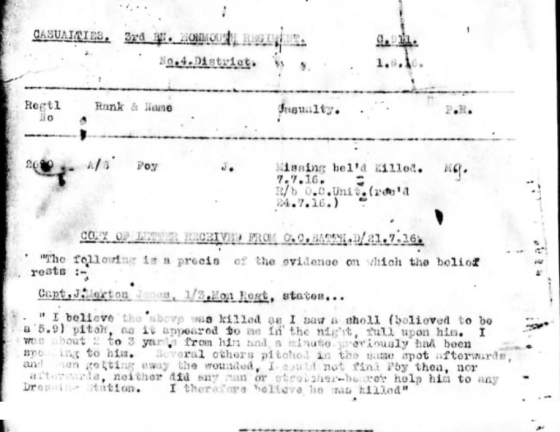
They found themselves at the Somme in July 1916 under withering artillery fire. On 7 July 1916, on the front lines, Sergeant Foy found himself just a few feet from his company’s commanding officer, Captain J. Merton Jones, who wrote in the casualty report:

I believe [Thomas Foy] was killed as I saw a shell (believed to be a 5.9) pitch, as it appeared to me in the night,  full upon him. I was about 2 to 3 yards from him and a minute previously had been [?] to him. Sever others pitched in the same spot afterwards and then getting away the wounded, I could not find Foy then, nor afterwards, neither did any man or stretcher-bearer help him to any Dressing Station. I therefore believe he was killed.


thomas_foy_snippet2

My third-great-uncle Thomas Foy was killed at the Battle of the Somme on 7 July 1916, one of over 95,000 British soldiers to die on this French battlefield. He is buried at the Mill Road Cemetery in Thiepval, France.

thomas_foy_1916_headstone_findagrave

Source:
“British Army WWI Service Records, 1914-1920,” images, Fold3 (https://www.fold3.com/image/510132225 : accessed 13 Nov 2016), record for Thomas Foy, 3rd Monmouthshire Regiment, page 325; National Archives of the UK, London, England.

Photo of the Day – March 23, 2015

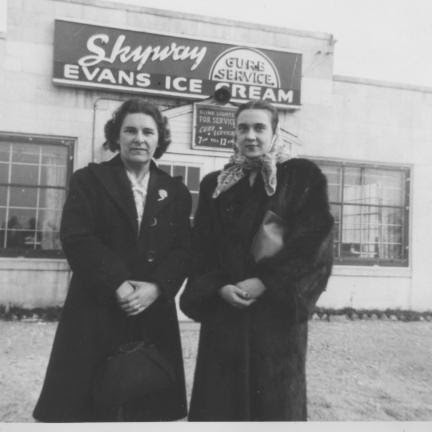
I can’t put a specific date or location on this photo, but my grandmother Jean Groucutt Lowry and her mother-in-law Margaret Pepperney Lowry look to be on a road trip. They probably stopped for gas or a quick bite to eat and one of their husbands asked for a quick photo. Neither looks particularly happy to be posing for the camera.
Source:
Mary Margaret Pepperney Lowry (1902-1980) and Jean Groucutt Lowry (1924-1986), photograph, taken at unknown location, in late 1940s; digital image, photocopy of original, scanned in 2013 by Joseph Lowry; privately held by Mary McCaffrey, [address for private use], Canton, Ohio. Two women standing in front of a restaurant. Provenance is Charles Lowry to Mary McCaffrey.

Photo of the Day – January 15, 2015

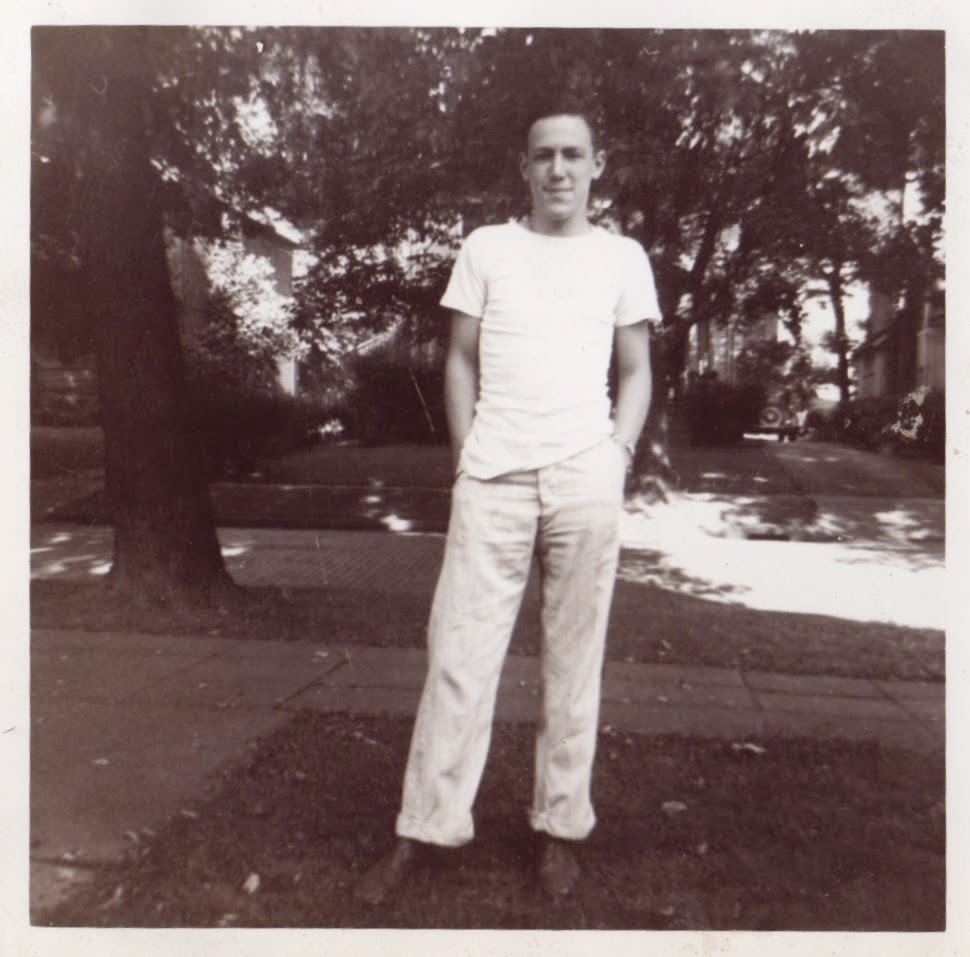
This is my grandmother Jean Groucutt Lowry around 1940.
This is post number 200 to my blog. Thanks for reading!

Source:
Jean Groucutt Lowry (1924-1987), photograph, taken at unknown location, in about 1940; digital image, photocopy of original, scanned in 2013 by Joseph Lowry; privately held by Mary McCaffrey, [address for private use], Canton, Ohio. Portrait of woman in white shirt with wide collar. Provenance is Charles Lowry to Mary McCaffrey.

Photo of the Day – January 9, 2015

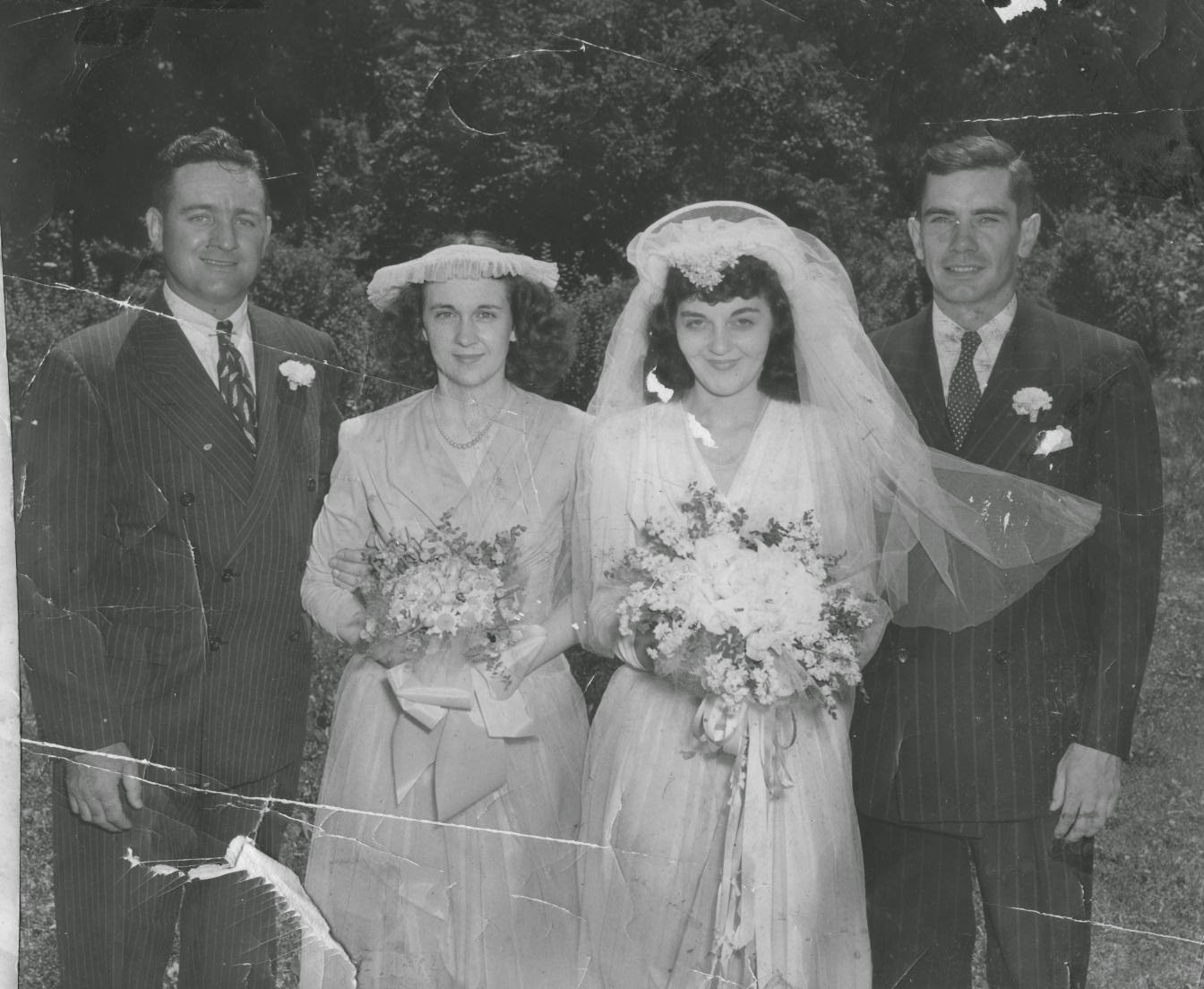
According to news reports, gladioli and larkspur graced the altar for the wedding of my great-aunt Kathleen Groucutt and Bob Sullivan on 13 Jul 1946. Kathleen’s sister, my grandmother Jean (Lowry), was maid of honor. Bob’s friend Phil Welsh served as best man. Kathleen and Bob were married at Saint Columba Cathedral by Rev. James Malone. Fr. Malone would become bishop of the Diocese of Youngstown in 1968.

Sentimental Sunday – Healthcare News

This story was written by my uncle Chuck Lowry and shared with his siblings. It’s published here with permission.

I thought with all the healthcare news around, I would offer three pieces of healthcare trivia from the Groucutt clan.

* Uncle Dickie was in the army, though I was a very small child at the time. I recall that Mother and Daddy Groc had a picture of him, in uniform, on a table in their living room on Elm Street, an apartment I think most of you will not remember. A bunch of the aunts and uncles were around, and I looked at the picture and said, “Oh, Uncle Dickie was in the army. Where was he shot?” That occasioned a great deal of hilarity. I don’t know any more about Dick’s military service now than I did then, but he didn’t get shot, thank God. In my defense, who was the only soldier I knew at that time? Dad. Who did get shot.

* It was in that same apartment on Elm Street that mom (Jean Groucutt Lowry) fell, heavily, when very pregnant. I’m not sure which baby she was carrying at the time, but if I had to guess, I would say Mary or Joan. We were there on a late Sunday morning or early Sunday afternoon, and mom went upstairs to use the bathroom. The stairs, as I recall, were somewhat winding and were linoleum-covered. On her way downstairs, she tripped or slipped or something two or three steps from the bottom and broke her shoulder. I remember seeing her lying on the floor in a black and white maternity dress. Isn’t it amazing what you remember? Anyway, the ambulance came and took her to St. E’s, where her shoulder was tended to. Does anybody remember that?

* If my Latin is good enough to read a simple inscription, I can tell you that St.Columba Cathedral was destroyed by fire (incendio destructa) in 1954 and rebuilt (reaedificata) in 1956. Daddy Groc was a volunteer bookkeeper at the cathedral. At some point before the fire–because I remember that it was at the old cathedral, not the new one–he tripped going down the stone steps and broke his kneecap. He was in the hospital for a couple days and walked with crutches for some time after that.

Ah, the memory bank.

Sources:
Charles Lowry, Brooklyn, New York, [e-mail for private use], to Lowry Family e-mail, 2 Jul 2012, “Heath Care Notes,” Local Folders: Genealogy : Bloggable!; privately held by Joe Lowry, [e-mail &address for private use], Sterling, VA, 2012.